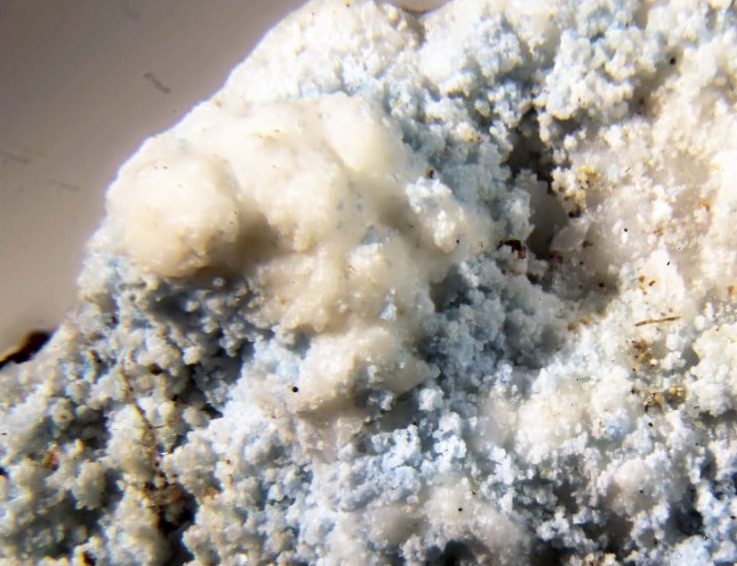
Colorless crystals aggregates of the rare mineral of simple chemistry (MgCO3) nesquehonite from a locality in Salers, France (Salers, Cantal, Auvergne-Rhône-Alpes, France), and associated to an unknown pale blue mineral, that is maybe cuprian nesquehonite. Ex Vandenbroucke Museum collection specimen, from Waregem, Belgium. — Photo: David Hospital · CC BY-SA 4.0
Nesquehonite
Magnesium carbonate trihydrate — described in 1890 and named for Nesquehoning, Pennsylvania.
Intro adapted from Wikipedia (CC BY-SA).
Nesquehonite is an IMA-recognized mineral species in the carbonate class, with the chemical formula Mg(CO₃)·3H₂O.
It crystallizes in the monoclinic crystal system (space group P2_1/n).
Key properties: Mohs hardness 2.5; specific gravity 1.82–1.85; Vitreous to slightly greasy luster; optically biaxial.
IMA symbol Nes, grandfathered status — known before the IMA’s founding, named in 1890.
Typically recently formed under near-surface conditions, as efflorescences in coal mines; in fractures in serpentinites; deposits around springs; in caves due to loss of CO2 in waters.
It is found associated with Lansfordite, dypingite, calcite, aragonite, artinite, hydromagnesite, brucite, pyroaurite, monohydrocalcite.
The name refers to its first-noted occurrence at Nesquehoning, Pennsylvania, USA.