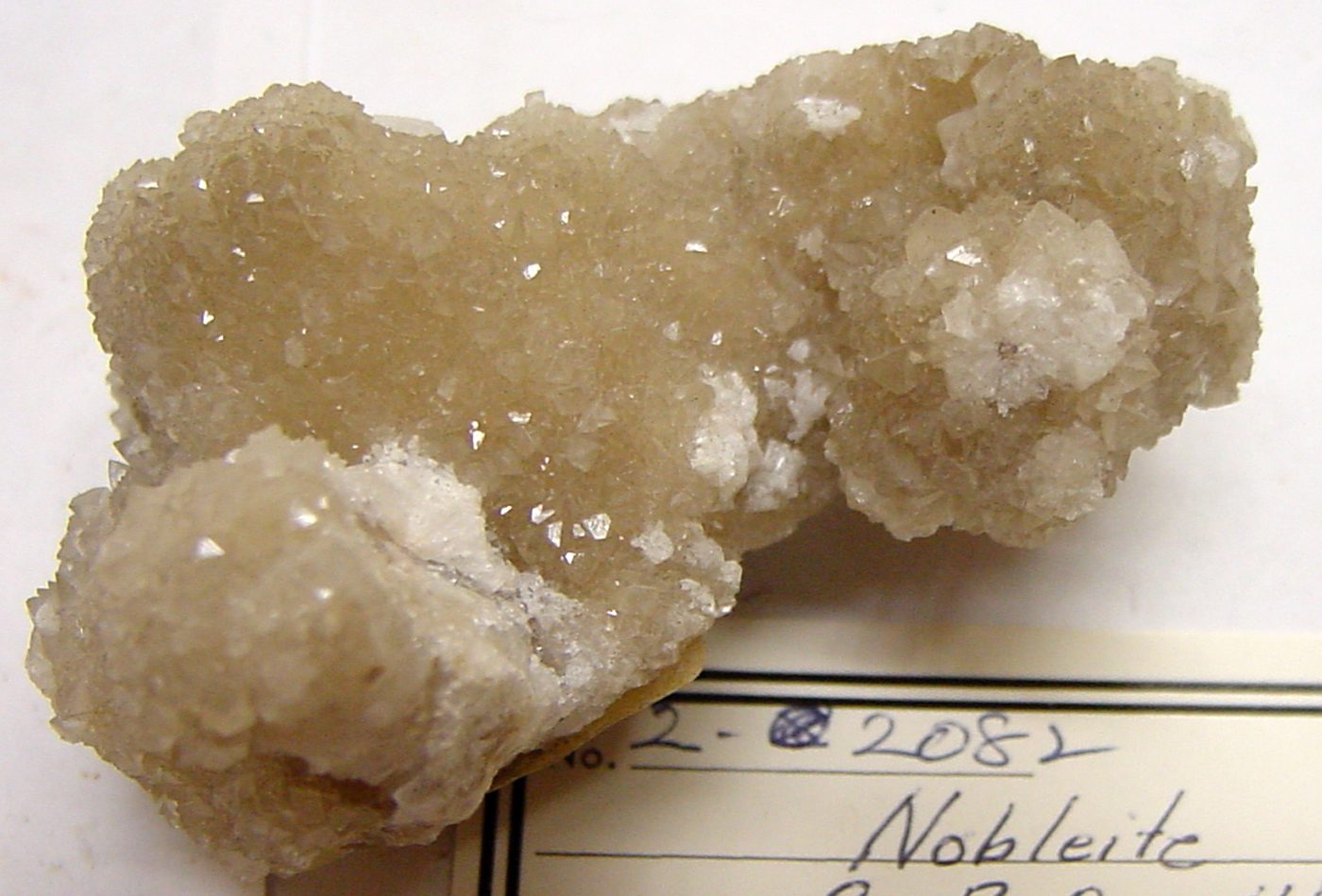
Nobleite. Collected by Robert Herod, 1988, from Death Valley, Inyo County, California. Mineral collection of Bringham Young University Department of Geology, Provo, Utah. Photograph by Andrew Silver. BYU index 2-2082, CaB_6O_9(OH)_2 x 3(H_2O). — Photo: Wikimedia Commons · Public domain
Nobleite
A rare hydrated calcium borate discovered in Death Valley in 1961, named for USGS geologist Levi Noble.
Intro adapted from Wikipedia (CC BY-SA).
Nobleite is an IMA-recognized mineral species in the borate class, with the chemical formula CaB₆O₉(OH)₂·3H₂O.
It crystallizes in the monoclinic crystal system (space group P2_1/a).
Key properties: Mohs hardness 3; specific gravity 2.09; White streak; Subvitreous, pearly on cleavages luster; optically biaxial.
IMA symbol Nob, IMA status: approved, named in 1961.
Typically a recent incrustation produced by weathering of colemanite and priceite veins in altered olivine basalt and basaltic clastic rocks (near the De Bely mine, California, USA).
It is found associated with Colemanite, meyerhofferite, gowerite, ulexite, ginorite, sassolite, gypsum, manganese oxide (near the De Bely mine, California, USA).
The mineral was named to honor Dr. Levi Fatzinger Noble (1882-1965), geologist with the U.S. Geological Survey, who studied the Death Valley borate deposits.