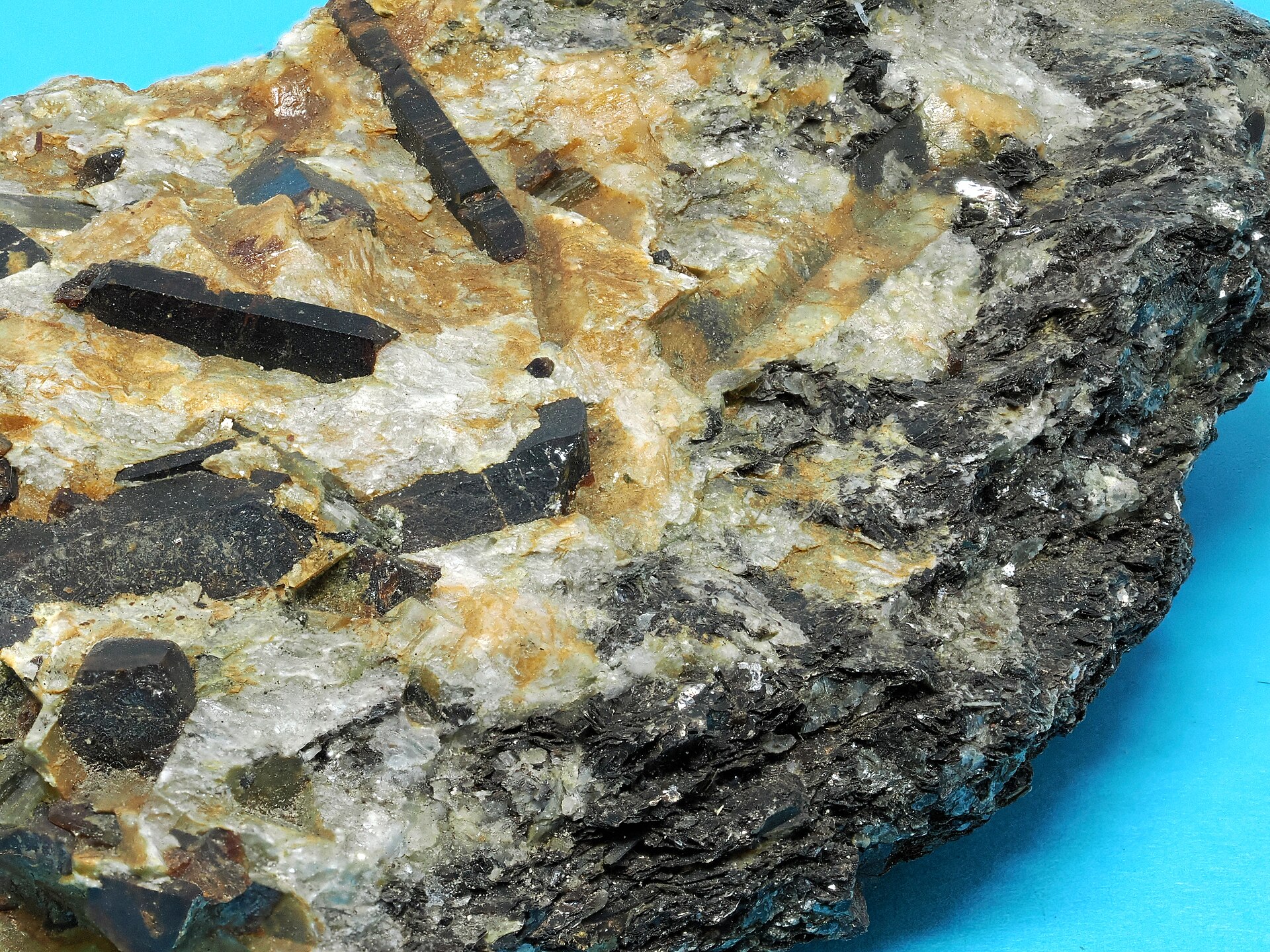
Staurolite, Paragonite, Biotite Locality: Monte Campione, Ticino, Switzerland Weight: 157.4 g — Photo: HolDu · CC BY-SA 3.0 de
Paragonite
Also known as: Sodium mica.
The sodium analogue of muscovite — a white mica that barely mixes with its potassium sibling.
Intro adapted from Wikipedia (CC BY-SA).
Paragonite is an IMA-recognized mineral species in the silicate class, with the chemical formula NaAl₂(Si₃Al)O₁₀(OH)₂.
It crystallizes in the monoclinic crystal system (space group C2/c). It is a member of the Mica, Clay structural group.
Key properties: Mohs hardness 2.5; specific gravity 2.85; typically white or colorless or yellow; white streak; Pearly luster; refractive index 1.593; optically biaxial.
IMA symbol Pg, IMA status: approved, named in 1843.
Uncommon, but may be in large amounts, in low- to medium-grade metamorphic schists and phyllites, in muscovite-biotite gneisses, quartz veins, fine-grained sediments, and glaucophane-bearing rocks.
It is found associated with Kyanite, staurolite, muscovite, quartz, glaucophane, chlorite, garnet, tourmaline, calcite, actinolite.
The name comes from the Greek, paragon, for misleading, as it looks like talc.
Collections: Collector Favorites.