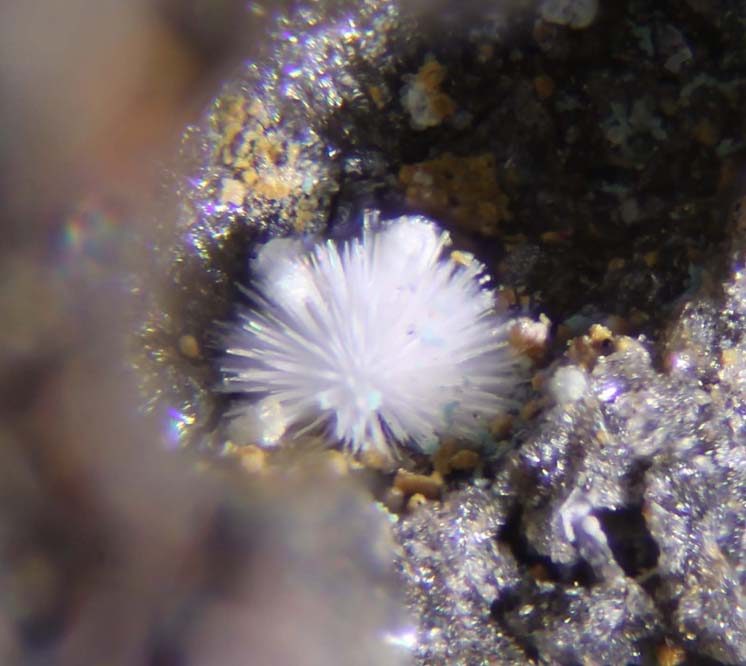
Outstanding white acicular crystals of parahopeite grouped in rossettes and isolated crystals, from this famous locality of Lautenthal (Harz Mountains, Lower Saxony, Germany). — Photo: David Hospital · CC BY-SA 4.0
Parahopeite
The triclinic dimorph of hopeite — a hydrated zinc phosphate of the oxidized zone.
Intro adapted from Wikipedia (CC BY-SA).
Parahopeite is an IMA-recognized mineral species in the phosphate class, with the chemical formula Zn₃(PO₄)₂·4H₂O.
It crystallizes in the triclinic crystal system (space group P-1). It is a member of the Parahopeite structural group.
Key properties: Mohs hardness 3.5–4; specific gravity 3.31; Vitreous, pearly on cleavages luster; optically biaxial.
IMA symbol Phop, grandfathered status — known before the IMA’s founding, named in 1908.
Found as a secondary mineral in the oxidized zone of some zinc-bearing hydrothermal mineral deposits.
It is found associated with Hemimorphite, tarbuttite, hopeite, scholzite, spencerite, pyromorphite.
Its name comes from the Greek para, for near, and its dimorphous relation to hopeite.