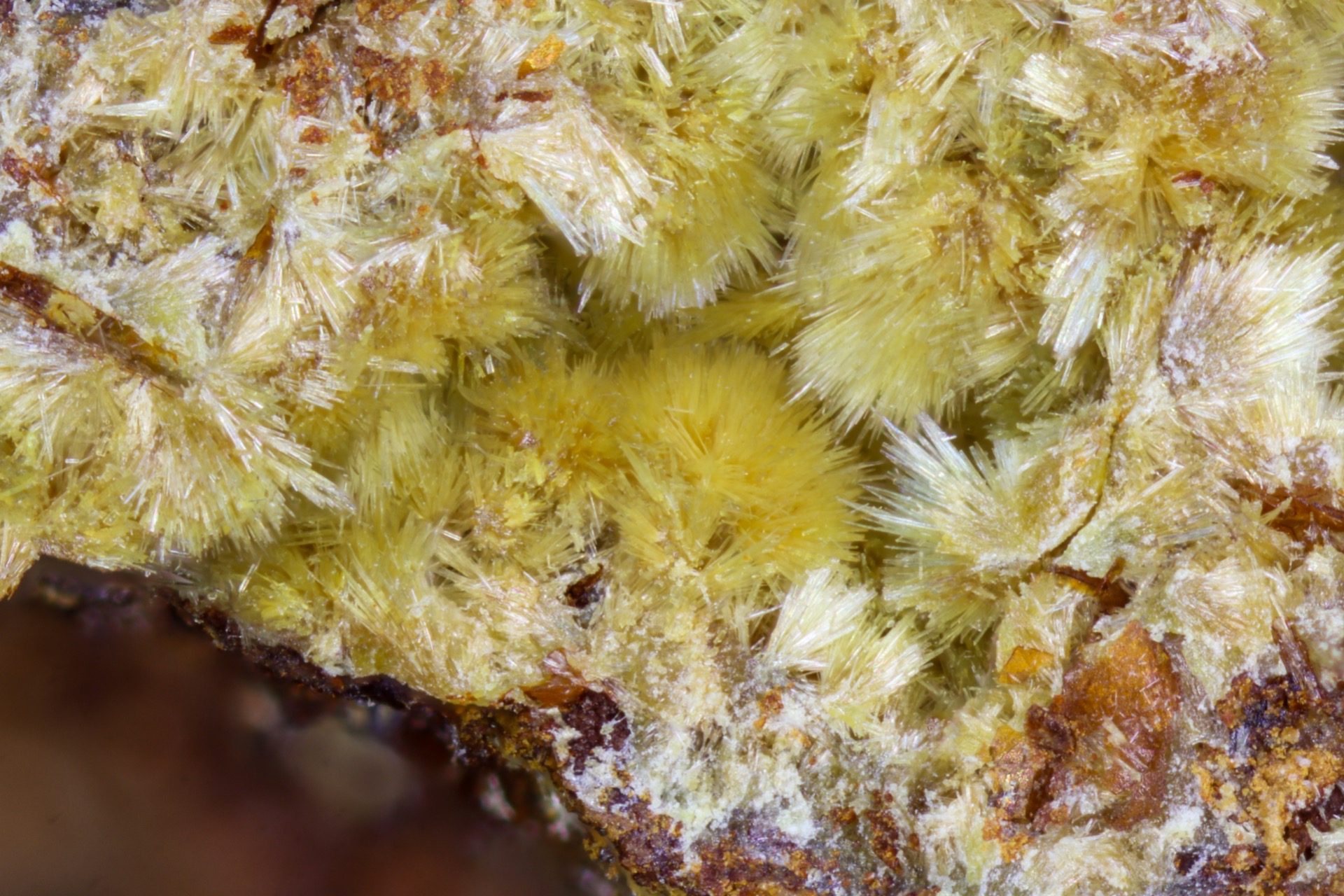
Parsonsite Field of view: 5 mm Locality: La Faye Mine, Grury, Charolles, Saône-et-Loire, Bourgogne-Franche-Comté, France ( locality at mindat.org ) — Photo: Henk Smeets – tomeikminerals.com · CC BY 4.0
Parsonsite
A lead-uranyl phosphate — about half lead and a quarter uranium by weight — forming lath-like crystals and powdery crusts.
Intro adapted from Wikipedia (CC BY-SA).
Parsonsite is an IMA-recognized mineral species in the phosphate class, with the chemical formula Pb₂(UO₂)(PO₄)₂.
It crystallizes in the triclinic crystal system (space group P-1).
Key properties: Mohs hardness 2.5–3; specific gravity 5.72–5.75; Subadamantine to slightly greasy luster; optically biaxial.
IMA symbol Pso, grandfathered status — known before the IMA’s founding, named in 1923.
Found as a secondary mineral in the oxidized zone of some hydrothermal uranium deposits.
It is found associated with Torbernite, kasolite, dewindtite (Kasolo, Congo); autunite, phosphuranylite (Ruggles mine, New Hampshire, USA); pyromorphite, torbernite, autunite (Lachaux.
The mineral was named to honor Arthur Leonard Parsons (1873–1957), Professor of Mineralogy, University of Toronto, Toronto, Canada.