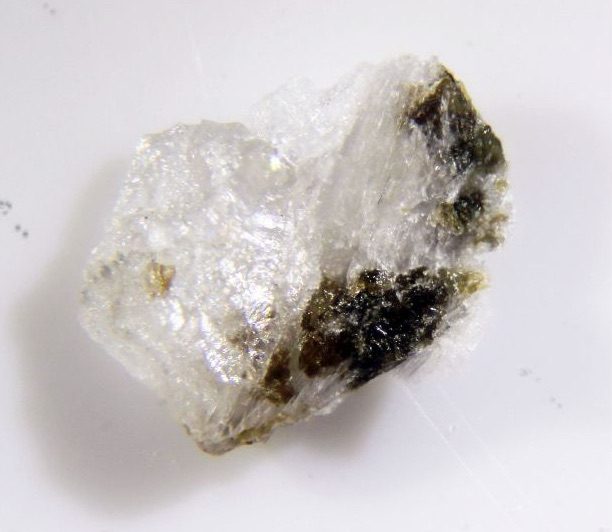
White crystal group of the extremely rare mineral partheite from the type locality in Turkey (Belenköysirti Hill, Doganbaba,, Yeşilova District, Burdur Province, Turkey) and only one of the two known localities worldwide. Ex Vandenbroucke Museum collection from Waregem, Belgium. — Photo: David Hospital · CC BY-SA 4.0
Parthéite
A calcium-aluminium zeolite whose open framework channels let water and gases pass through.
Intro adapted from Wikipedia (CC BY-SA).
Parthéite is an IMA-recognized mineral species in the silicate class, with the chemical formula Ca₂(Si₄Al₄)O₁₅(OH)₂·4H₂O.
It crystallizes in the monoclinic crystal system (space group C2/c).
Key properties: Mohs hardness 4; specific gravity 2.39–2.45; Vitreous luster; refractive index 1.554; optically biaxial.
IMA symbol Pth, IMA status: approved, named in 1978.
Found in rodingite dikes within an ophiolite (Doģanbaba, Turkey); in veins cutting a gabbroic intrusive complex (Denezhkin Kamen complex, Russia).
It is found associated with Prehnite, thomsonite, augite (Doģanbaba, Turkey); chlorite, tremolite (Denezhkin Kamen complex, Russia).
In honor of Professor Erwin Parth¶e, crystallographer at the University of Geneva, Geneva, Switzerland.