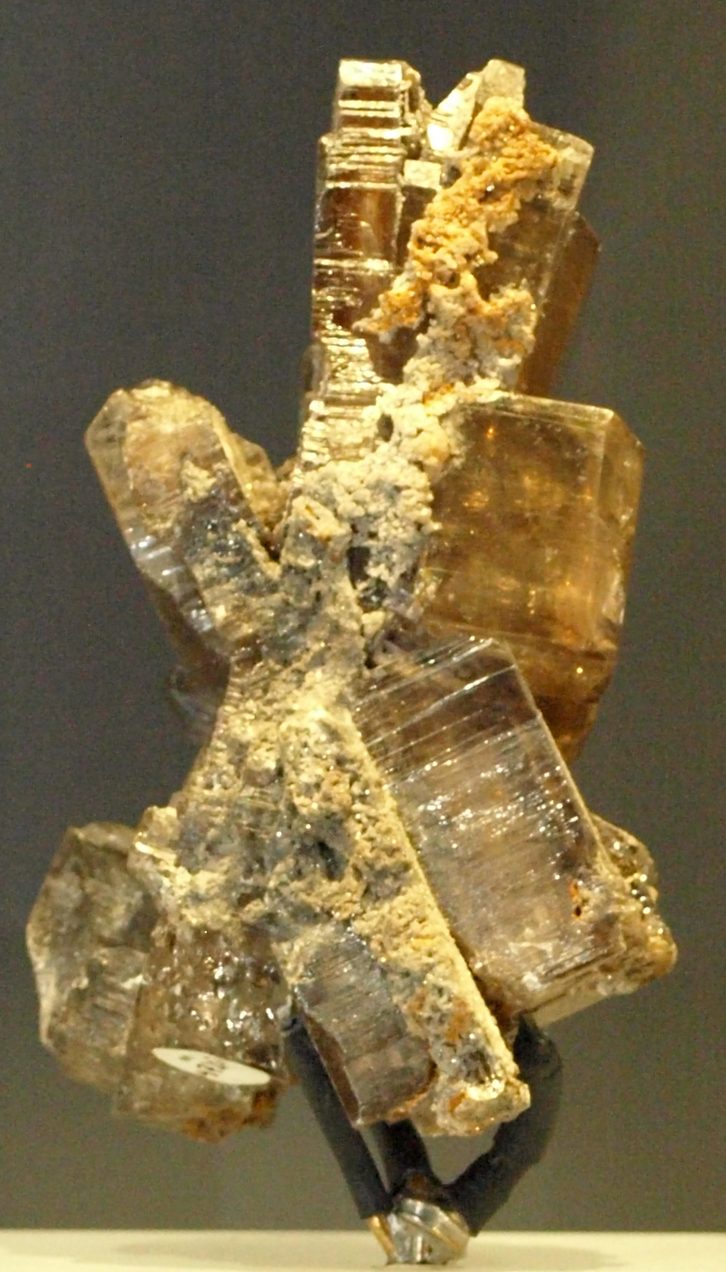
An example of the mineral Phosgenite on display in the Vale Inco Limited Gallery of Minerals at the Royal Ontario Museum. — Photo: User:Captmondo · CC BY-SA 3.0
Phosgenite
A rare lead chlorocarbonate — colorless, adamantine tetragonal tablets.
Intro adapted from Wikipedia (CC BY-SA).
Phosgenite is an IMA-recognized mineral species in the carbonate class, with the chemical formula Pb₂(CO₃)Cl₂.
It crystallizes in the tetragonal crystal system (space group P4/mbm).
Key properties: Mohs hardness 2–3; specific gravity 6.12–6.15; White streak; Adamantine luster; refractive index 2.132; optically uniaxial.
IMA symbol Pho, grandfathered status — known before the IMA’s founding, named in 1841.
Uncommon, typically produced through alteration of galena in the oxidized zone of hydrothermal lead deposits, or by reaction of sea water with other lead minerals.
It is found associated with Cerussite, anglesite, matlockite, laurionite.
The name comes from phosgene, COCl2, composed of elements in the mineral’s composition.