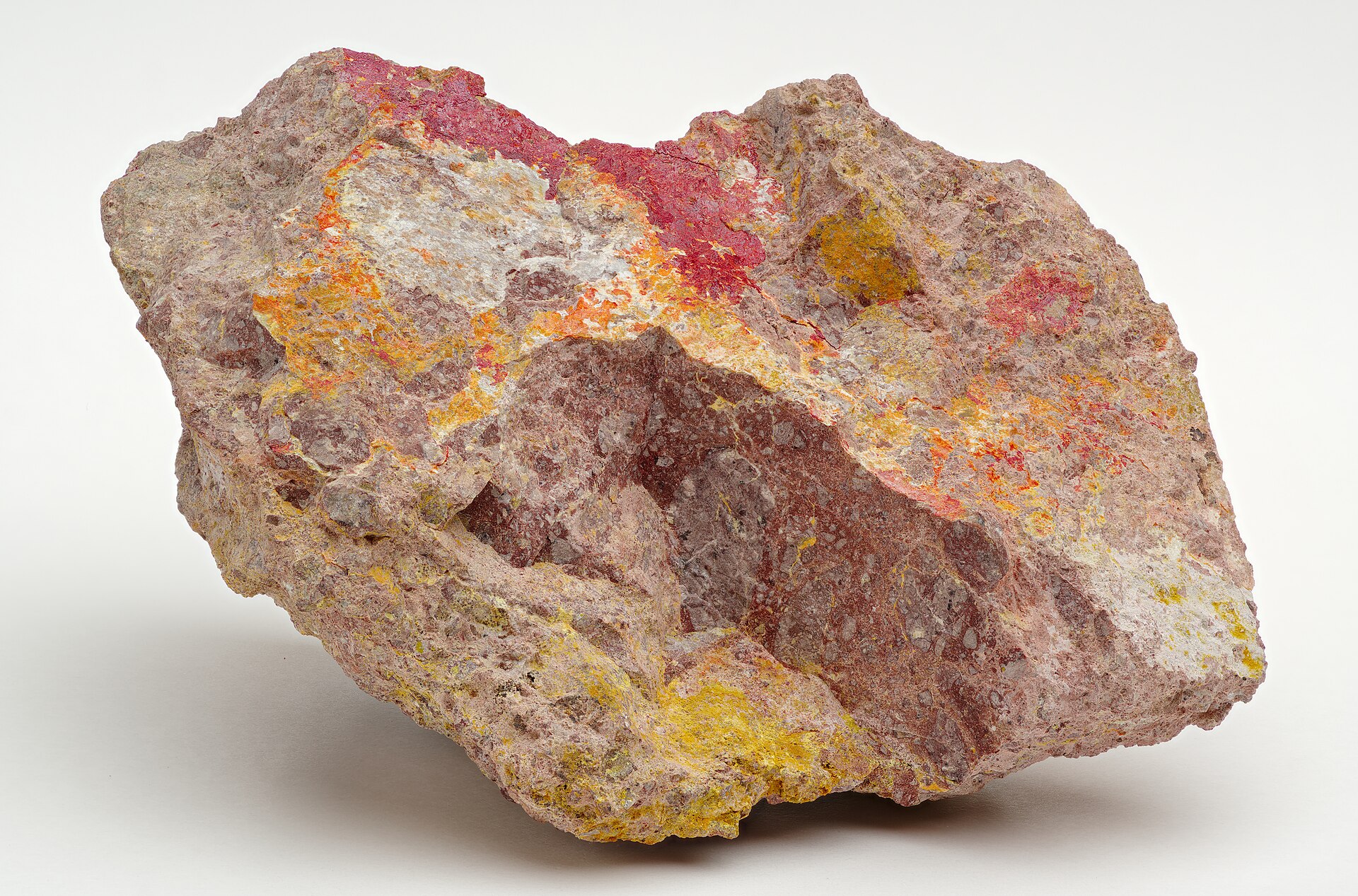
Phoenicochroite, Mimetite Dimensions: 19.0 cm (Weight: 659.2 g) Locality: Potter Cramer Claim, Wickenburg, Arizona, USA — Photo: Jan Czeczotka · CC BY-SA 4.0
Phoenicochroite
A basic lead chromate forming striking orange-red crystals — first found in 1839 in Russia's Beryozovskoye deposit.
Intro adapted from Wikipedia (CC BY-SA).
Phoenicochroite is an IMA-recognized mineral species in the chromate class, with the chemical formula Pb₂O(CrO₄).
It crystallizes in the monoclinic crystal system (space group C2/m).
Key properties: Mohs hardness 2.5; specific gravity 7.01; typically red or orange; Brick-red to yellowish orange streak; Adamantine to resinous, glistening luster; refractive index 2.49; optically biaxial.
IMA symbol Phc, IMA status: approved, named in 1833.
A rare secondary mineral found in the oxidized zone of chromium-bearing hydrothermal lead deposits.
It is found associated with Crocoite, vauquelinite, fornacite, hemihedrite, iranite, pyromorphite, mimetite, cerussite, leadhillite, galena, calcite, fluorite, quartz.
Its name comes from the Greek for deep red and color, in allusion to its typical color.
Collections: Collector Favorites, Rare & Remarkable.