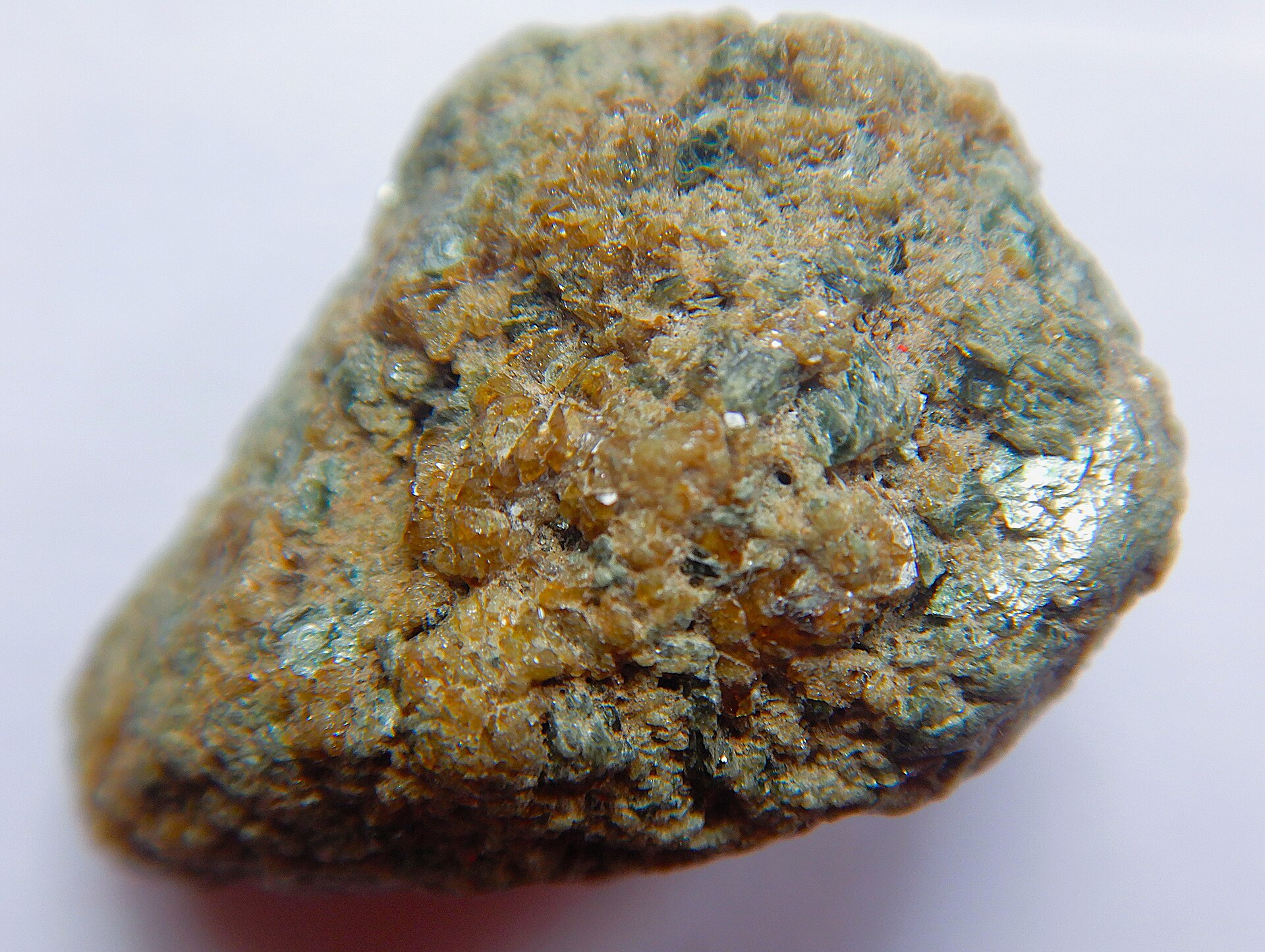
Mineral with phlogopite and vesuvianite crystals, from a beach at Lake Bracciano (Anguillara Sabazia, Lazio) — Photo: Albarubescens · CC BY-SA 4.0
Phlogopite
Also known as: Biotite (Mg endmember), Amber mica.
The magnesium end-member of biotite — a brown 'magnesium mica' of ultramafic rocks and marbles.
Intro adapted from Wikipedia (CC BY-SA).
Phlogopite is an IMA-recognized mineral species in the silicate class, with the chemical formula KMg₃(AlSi₃O₁₀)(OH)₂.
It crystallizes in the monoclinic crystal system (space group Cm). It is a member of the Mica, Clay structural group.
Key properties: Mohs hardness 2–2.5; specific gravity 2.78–2.85; typically brown or yellow or red or green; White streak; Pearly to submetallic on cleavage luster; refractive index 1.576; optically biaxial.
IMA symbol Phl, grandfathered status — known before the IMA’s founding, named in 1841.
Found in metamorphosed dolostones and magnesium-rich limestones; in ultramafic rocks as kimberlites, peridotites, lamproites, and serpentinites.
It is found associated with Dolomite, calcite, diopside, tremolite, scapolite, vesuvianite, apatite, titanite, epidote, olivine, augite, magnetite.
Its name comes from the Greek for firelike, referring to an oft-seen reddish tint.
Collections: Everyday Minerals, Collector Favorites.