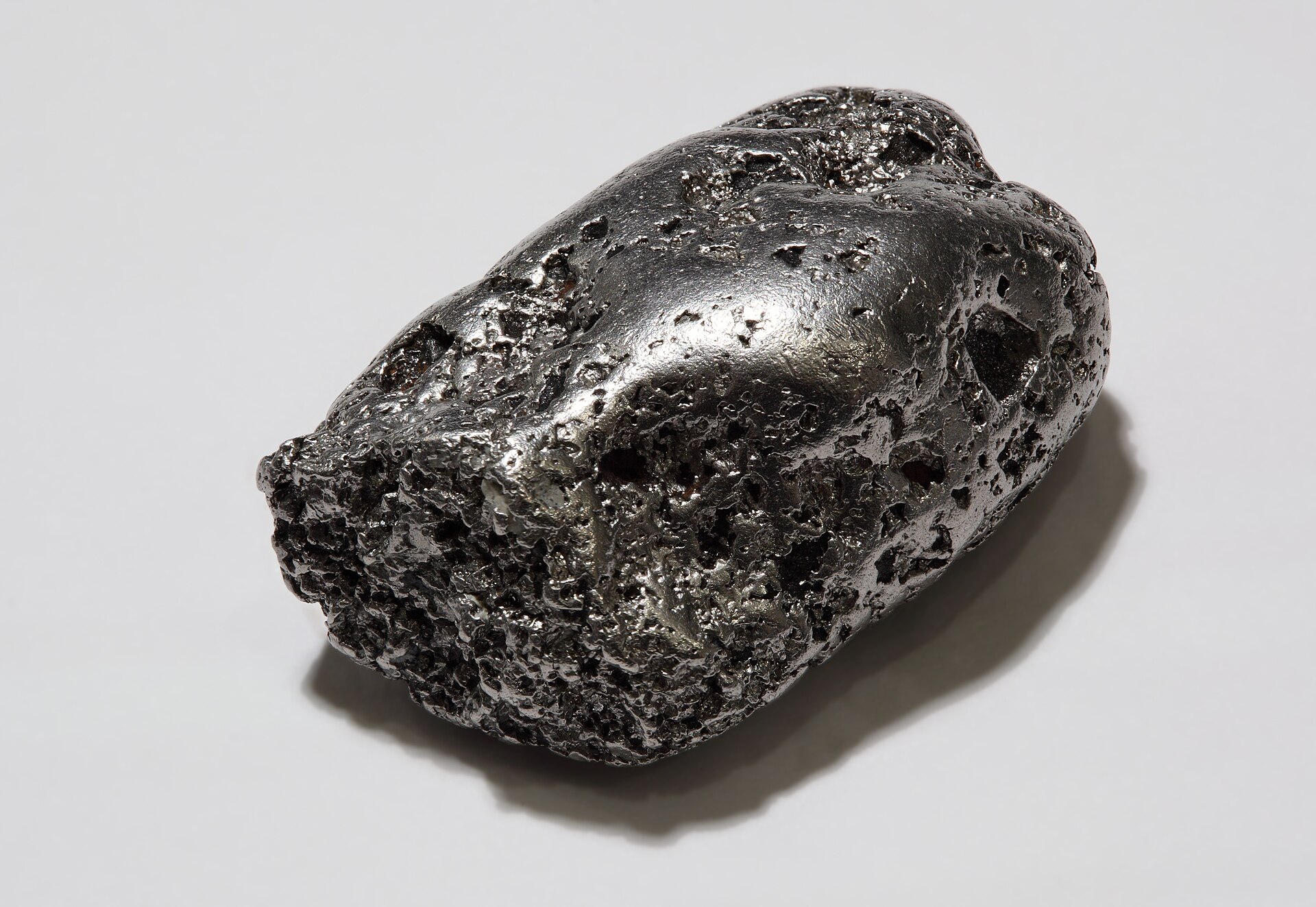
native Platinum nugget, locality Kondyor mine, Khabarovsk Krai, Russia. Size ca. 35 × 23 × 14 mm, weight ca. 112g = 3.6 oz. Collection: M.R. — Photo: Alchemist-hp (talk) (www.pse-mendelejew.de) · FAL
Platinum
Also known as: Native platinum.
A dense, unreactive precious metal (symbol Pt, atomic number 78) — a native element in placers and layered intrusions.
Intro adapted from Wikipedia (CC BY-SA).
Platinum is an IMA-recognized mineral species in the native element class, with the chemical formula Pt.
It crystallizes in the cubic crystal system (space group Fm3m). It is a member of the Copper structural group.
Key properties: Mohs hardness 4–4.5; specific gravity 14–19; typically gray or white; steel-gray streak; Metallic. R: (400) 60.5, (420) 62.3, (440) 63.8, (460) 65.1, (480) 66.3, (500) 67.5, (520) 68.6, (540) 69.5 luster.
IMA symbol Pt, grandfathered status — known before the IMA’s founding, named in 1750.
Chiefly in placer deposits, or in mafic and ultramafic igneous rocks; rarely in hydrothermal quartz veins or contact metamorphic deposits.
It is found associated with Pt–Fe alloys, chalcopyrite, chromite, magnetite.
The name comes from the Spanish platina, diminutive of plata, silver.
Collections: Metals & Native Elements, Rare & Remarkable.