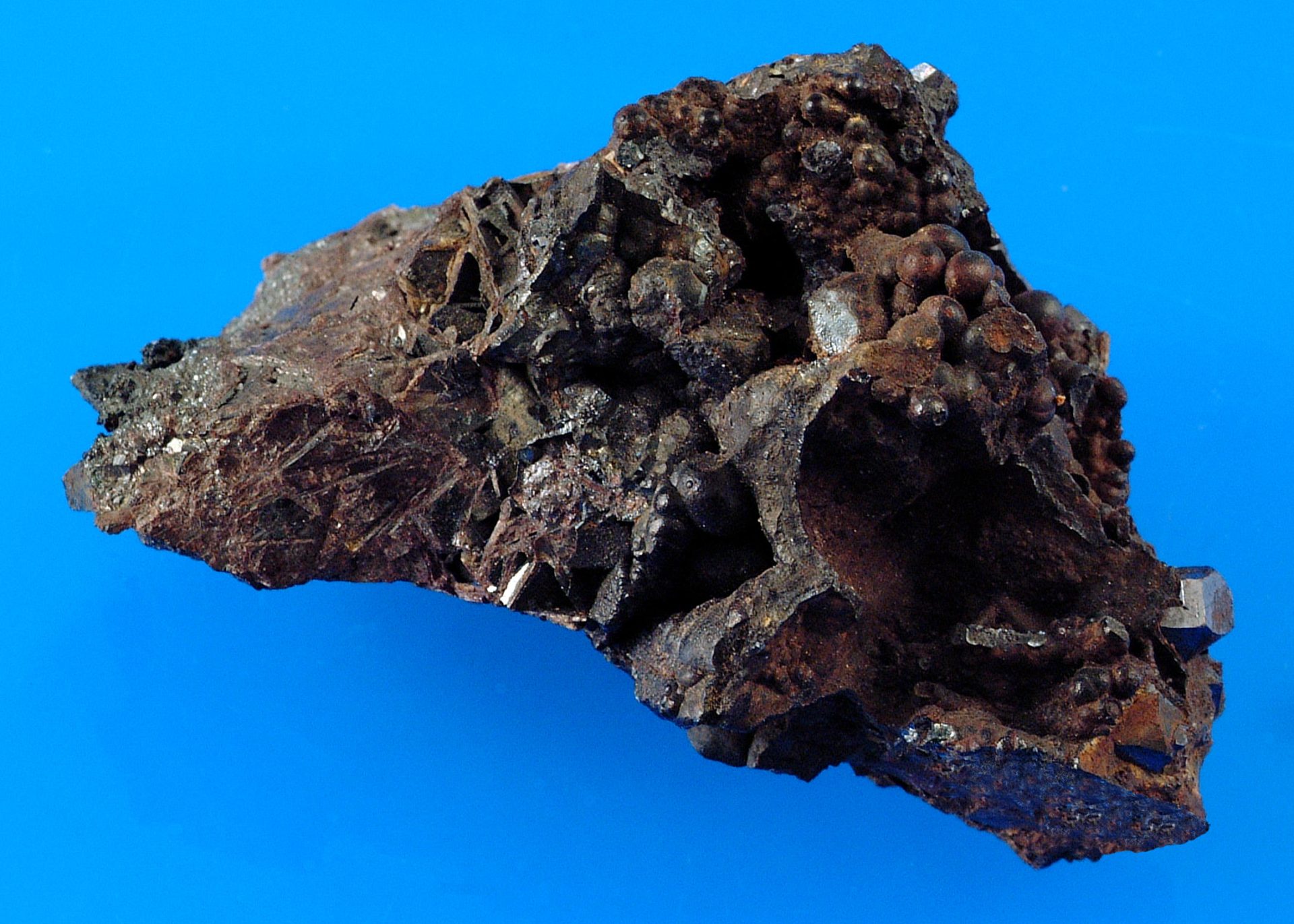
This sample contains crystals of the relatively rare mineral plattnerite (PbO2) with finer grained limonite-goethite dust on top. The plattnerite is dark brown to black, and the limonite-goethite only slightly lighter in color. Plattnerite is named after the German metallurgist, K. F. Plattner (1800-1858). This specimen is about 5 cm in longest dimension. — Photo: Shannon Heinle · CC0
Plattnerite
The β-form of lead dioxide — a rare black mineral named in 1845 for mineralogist Karl Plattner.
Intro adapted from Wikipedia (CC BY-SA).
Plattnerite is an IMA-recognized mineral species in the oxides & hydroxide class, with the chemical formula PbO₂.
It crystallizes in the tetragonal crystal system (space group P4_2/mnm). It is a member of the Rutile structural group.
Key properties: Mohs hardness 5.5; specific gravity 9.564; Chestnut-brown streak; Bright metallic to adamantine; tarnishing dull on exposure luster; optically uniaxial.
IMA symbol Ptn, grandfathered status — known before the IMA’s founding, named in 1845.
Found in weathered hydrothermal base-metal deposits, oxidized typically in arid climates.
It is found associated with Cerussite, smithsonite, hemimorphite, leadhillite, hydrozincite, rosasite, aurichalcite, murdochite, pyromorphite, wulfenite, calcite, quartz.
The mineral was named to honor Carl Friedrich Plattner (1800–1858), Professor of Metallurgy and Assaying, Mining Academy, Freiberg, Germany.