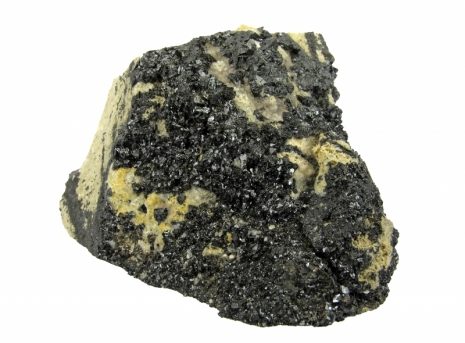
:6.2 x 4.4 x 3.2 cm. Discovered in 1979, povondraite is a relatively new member of the Tourmaline Group. The crystals here are black, lustrous, and 1-2 mm in size. They richly cover one side of the matrix, and the povondraite winds its way through the fissures in the rock. The host rock, by the way, is the very unusual Locotal Breccia, a metamorphosed evaporite deposit. A fine example of this new species, and even better in person, with the luster really shines. Originally acquired from Alfredo Petrov and John Attard. Alfredo brought them out of Bolivia at the time, directly. Ex. Hoppel Collection. From: Alto Chapare mining district, Chapare Province, Cochabamba, Bolivia — Photo: Robert M. Lavinsky · CC BY-SA 3.0
Povondraite
A rare dark tourmaline-group mineral rich in ferric iron, with a resinous luster.
Intro adapted from Wikipedia (CC BY-SA).
Povondraite is an IMA-recognized mineral species in the silicate class, with the chemical formula NaFe³⁺₃(Fe³⁺₄Mg₂)(Si₆O₁₈)(BO₃)₃(OH)₃O.
It crystallizes in the hexagonal crystal system (space group R3m). It is a member of the Tourmaline structural group.
Key properties: Mohs hardness 7; specific gravity 3.26; Brown streak; Resinous, more or less splendent luster; optically uniaxial.
IMA symbol Pov, IMA status: approved, named in 1979.
Very rare, in fractures and lining cavities in schist metamorphosed from sedimentary rocks.
It is found associated with Quartz, potassic feldspar, muscovite, schorl, riebeckite, magnesite.
The name refers to Dr. Pavel Povondra, Charles University, Prague, Czech Republic, in recognition of work on the chemistry of the tourmaline group.