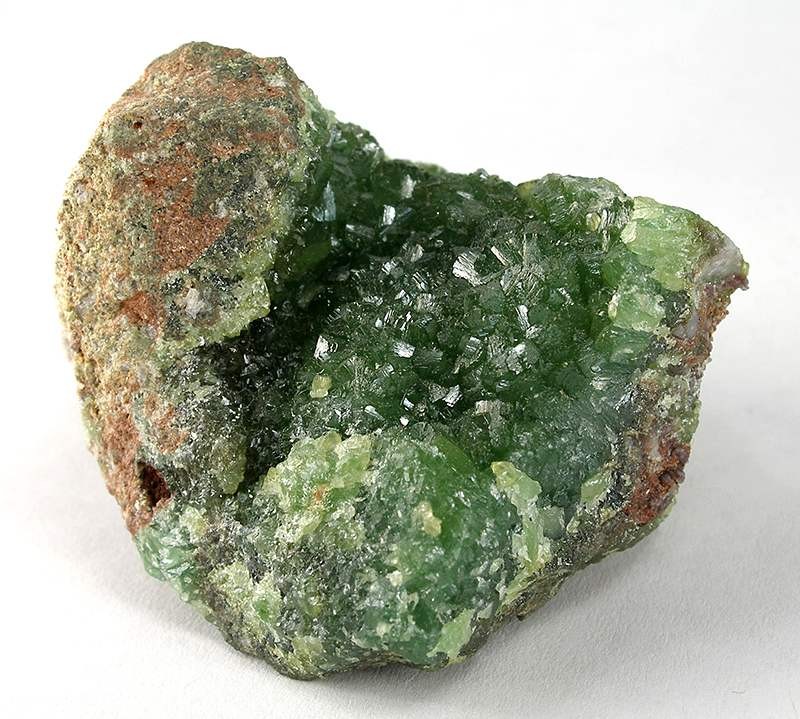
Powellite Locality: Jardinera No. 1 Mine, Inca de Oro, Chañaral Province, Atacama Region, Chile (Locality at mindat.org) Another specimen, with limey-green colo — Photo: Robert M. Lavinsky · CC BY-SA 3.0
Powellite
Calcium molybdate — a tetragonal mineral of oxidized molybdenum deposits.
Intro adapted from Wikipedia (CC BY-SA).
Powellite is an IMA-recognized mineral species in the molybdate class, with the chemical formula Ca(MoO₄).
It crystallizes in the tetragonal crystal system (space group I4_1/a). It is a member of the Scheelite structural group.
Key properties: Mohs hardness 3.5–4; specific gravity 4.26; typically yellow or gray or brown; white streak; Subadamantine, resinous, pearly luster; refractive index 1.979; optically uniaxial.
IMA symbol Pwl, grandfathered status — known before the IMA’s founding, named in 1891.
An uncommon secondary mineral, typically formed in the oxidation zone of molybdenum-bearing hydrothermal mineral deposits, rarely in basalts, tactites, and granite pegmatites.
It is found associated with Molybdenite, ferrimolybdite, stilbite, laumontite, apophyllite.
The mineral was named to honor Major John Wesley Powell (1834–1902), American geologist and explorer, and Director of the U.S. Geological Survey.
Collections: Collector Favorites.