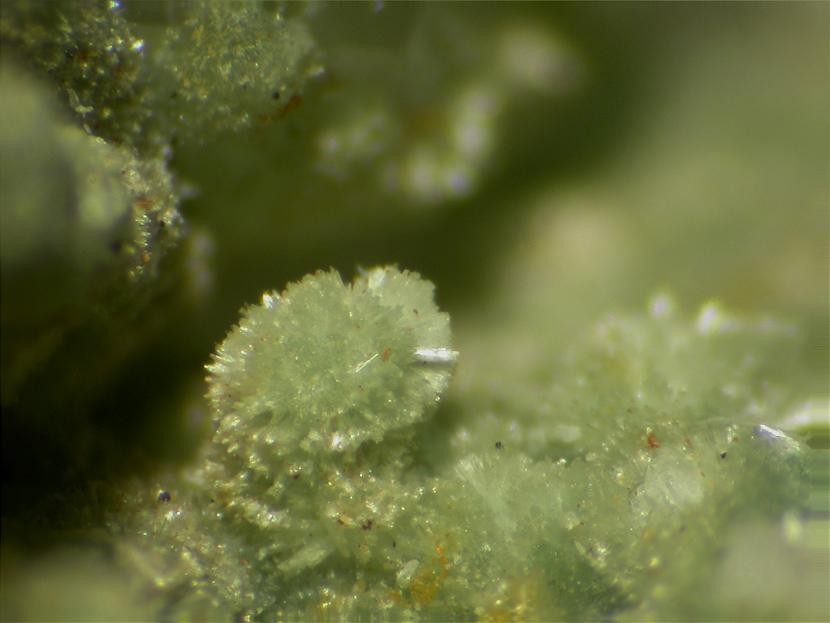
Pumpellyite-(Mg) Locality: Obri Dul (Riesental), Krkonoše Mts (Riesengebirge), Hradec Králové Region, Bohemia (Böhmen; Boehmen), Czech Republic Field of view 4 — Photo: Leon Hupperichs · CC BY-SA 3.0
Pumpellyite-(Mg)
Also known as: Pumpellyite.
Pumpellyite is a group of closely related sorosilicate minerals: pumpellyite-(Mg): Ca2MgAl2[Si2O6OH][SiO4](OH)2(OH) pumpellyite-(Fe2+): Ca2Fe2+Al2[Si2O6OH][SiO4](OH)2(OH) pumpellyite-(Fe3+): Ca2Fe3+Al2[Si2O6OH][SiO4](OH)2O pumpellyite-(Mn2+): Ca2Mn2+Al2[Si2O6OH][SiO4](OH)2(OH) pumpellyite-(Al): Ca2AlAl2[Si2O6OH][SiO4](OH)2O Pumpellyite crystallizes in the monoclinic-prismatic crystal system. It typically occurs as blue-green to olive green fibrous to lamellar masses. It is translucent and glassy with a Mohs hardness of 5.5 and a specific gravity of 3.2.
Intro adapted from Wikipedia (CC BY-SA).
Pumpellyite-(Mg) is an IMA-recognized mineral species in the silicate class, with the chemical formula Ca₂MgAl₂(Si₂O₇)(SiO₄)(OH)₂·H₂O.
It crystallizes in the monoclinic crystal system (space group A2/m). It is a member of the Pumpellyite structural group.
Key properties: Mohs hardness 6; specific gravity 3.18; typically green or brown; white streak; Vitreous luster; optically biaxial.
IMA symbol Pmp-Mg, IMA status: approved, named in 1925.
A widespread product of low-grade metamorphism of amygdaloidal basalts and diabases; in glaucophane schists and in graywackes.
It is found associated with Chlorite, epidote, actinolite, lawsonite, glaucophane, prehnite, zeolites, quartz.
The name refers to Raphael Pumpelly (1837–1923), pioneer student of the paragenesis of copper deposit minerals of the Keweenaw Peninsula, Michigan, USA, and dominant magnesium content.
Collections: Collector Favorites.