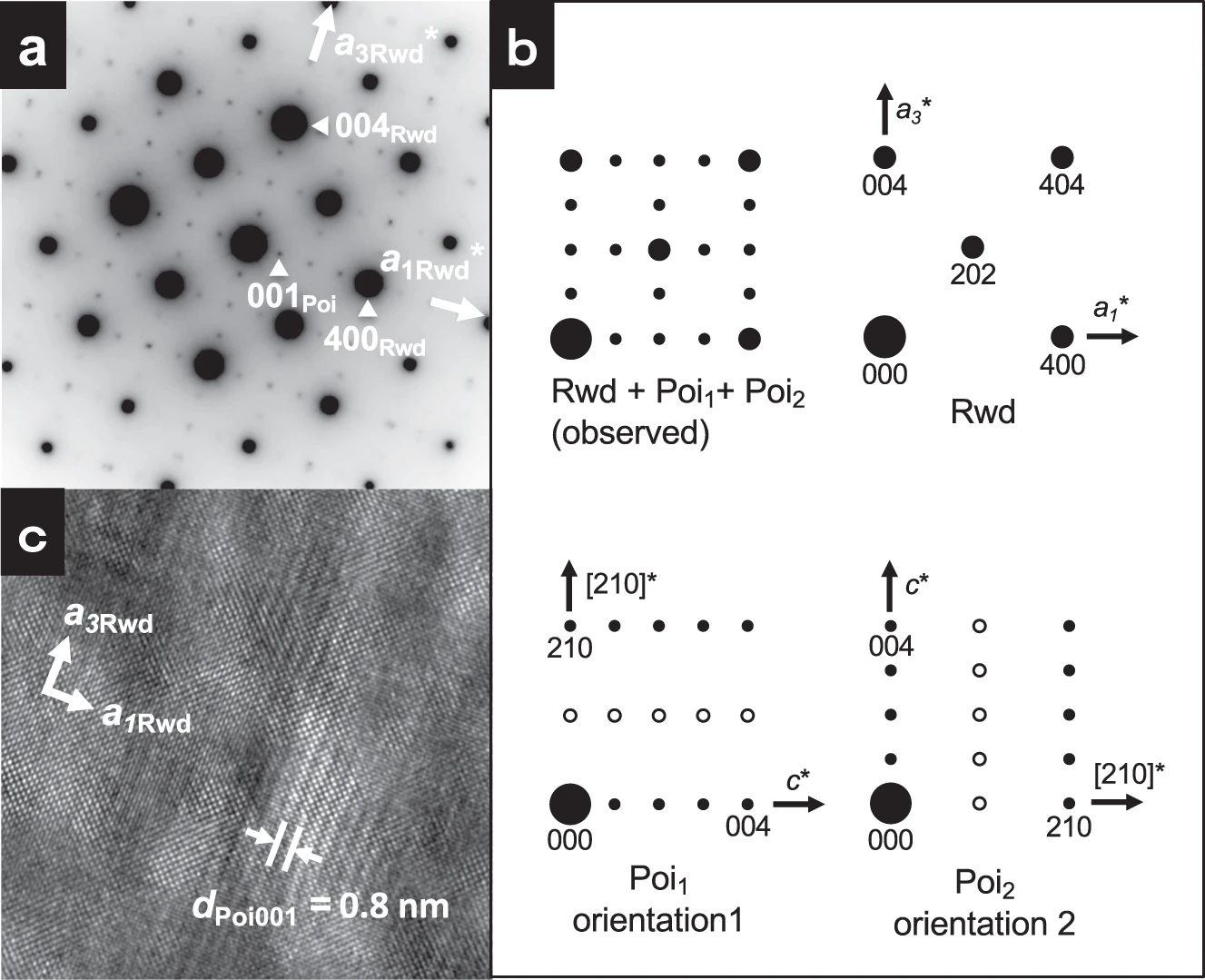
a Selected-area electron diffraction (SAED) pattern of a ringwoodite grain along the [010] zone axis and (b) its schematic illustration. The grain contains poirierite in two different but equivalent orientations (domain 1: Poi1, domain 2: Poi2). Domain 2 is rotated by 90° along [010]Rwd compared with the orientation of domain 1. The open circles denote diffraction spots from the poirierite caused by dynamical diffraction by the overlying host ringwoodite. c High-resolution transmission electron micrograph showing 0.8 nm fringes corresponding to dPoi001. The image is published in an open access article distributed under the terms and conditions of the Creative Commons Attribution (CC BY) license ( https://creativecommons.org/licenses/by/4.0/ ). — Photo: Naotaka Tomioka, Luca Bindi, Takuo Okuchi, Masaaki Miyahara, Toshiaki Iitaka, Zhi Li, Tsutomu Kawatsu, Xiande Xie, Narangoo Purevjav, Riho Tani & Yu Kodama · CC BY 4.0
Ringwoodite
The high-pressure spinel form of olivine — the major mineral of Earth's mantle transition zone.
Intro adapted from Wikipedia (CC BY-SA).
Ringwoodite is an IMA-recognized mineral species in the silicate class, with the chemical formula SiMg₂O₄.
It crystallizes in the cubic crystal system (space group Fd3m). It is a member of the Spinel structural group.
Key properties: specific gravity 3.9; refractive index 1.8; optically isotropic.
IMA symbol Rwd, IMA status: approved, named in 1968.
Found in veinlets cutting the matrix of meteorites and replacing olivine; probably produced during shock metamorphism.
It is found associated with Ma jorite, magnesian silicate glass.
The name refers to Professor Alfred Edward Ringwood (1930–1993), noted geochemist of the Australian National University, Canberra, Australia.