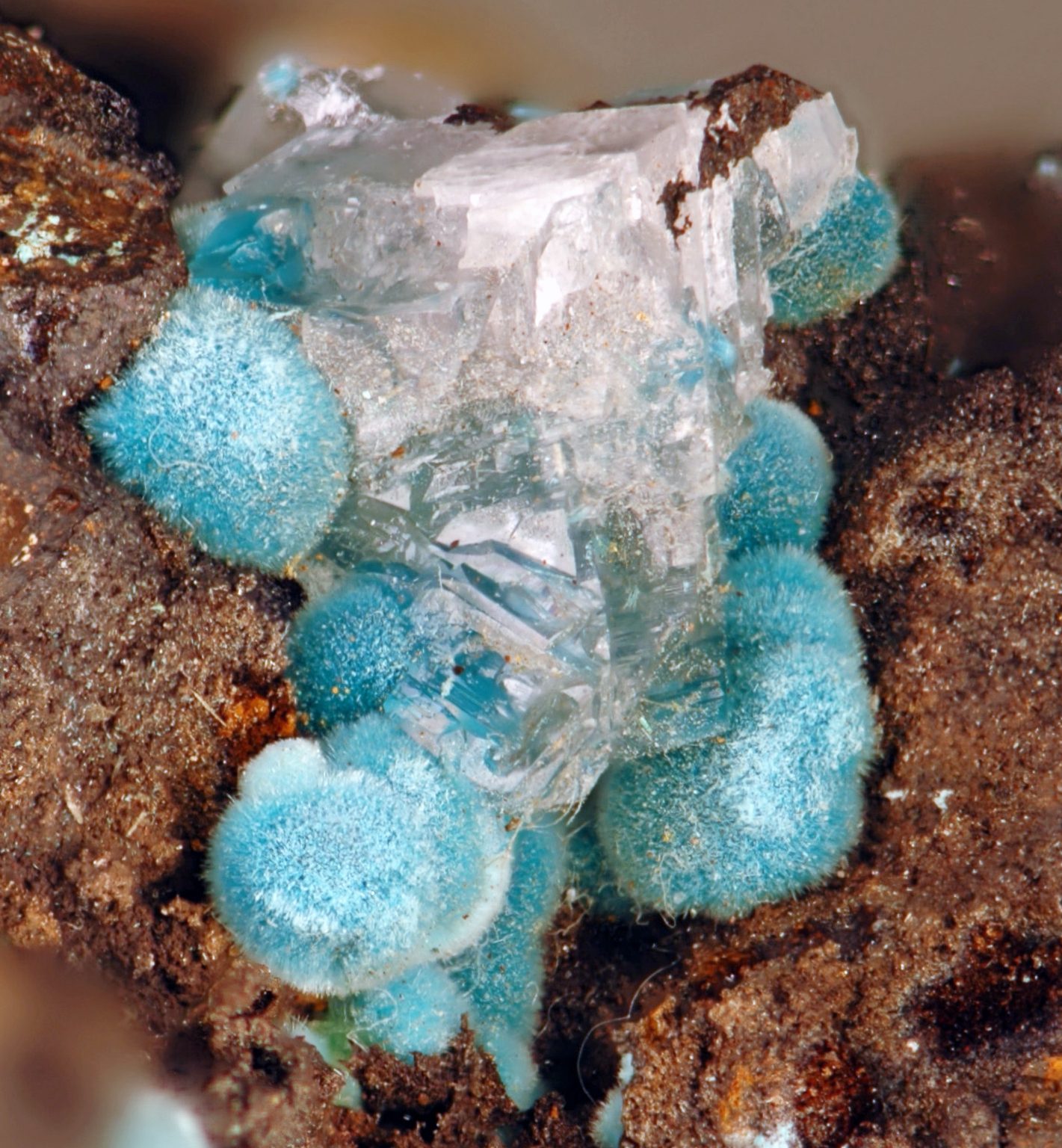
Rosasite on gossan. (field of view: ~1.6 cm across) A mineral is a naturally-occurring, solid, inorganic, crystalline substance having a fairly definite chemical composition and having fairly definite physical properties. At its simplest, a mineral is a naturally-occurring solid chemical. Currently, there are over 5100 named and described minerals - about 200 of them are common and about 20 of them are very common. Mineral classification is based on anion chemistry. Major categories of minerals are: elements, sulfides, oxides, halides, carbonates, sulfates, phosphates, and silicates. The carbonate minerals all contain one or more carbonate (CO3-2) anions. Rosasite is a copper zinc hydroxy-carbonate mineral, (Cu,Zn)2CO3(OH)2. It tends to form turqoise-colored, subrounded masses of tiny crystals. Photo gallery of rosasite: www.mindat.org/gallery.php?min=3447 — Photo: James St. John · CC BY 2.0
Rosasite
A green-blue copper-zinc carbonate-hydroxide of the oxidized zone — a minor ore indicator.
Intro adapted from Wikipedia (CC BY-SA).
Rosasite is an IMA-recognized mineral species in the carbonate class, with the chemical formula CuZn(CO₃)(OH)₂.
It crystallizes in the monoclinic crystal system (space group P2_1/a). It is a member of the Malachite structural group.
Key properties: Mohs hardness 4.5; specific gravity 4–4.2; refractive index 1.773; optically biaxial.
IMA symbol Rss, grandfathered status — known before the IMA’s founding, named in 1908.
Occurs as an uncommon secondary mineral in the oxidized zone of Cu–Zn-bearing deposits, typically formed by zinc-bearing solutions on primary copper minerals; may be of post-mine origin.
It is found associated with Malachite, aurichalcite, smithsonite, cerussite, hydrozincite, hemimorphite.
The name refers to its occurrence in the Rosas mine, Sardinia, Italy.