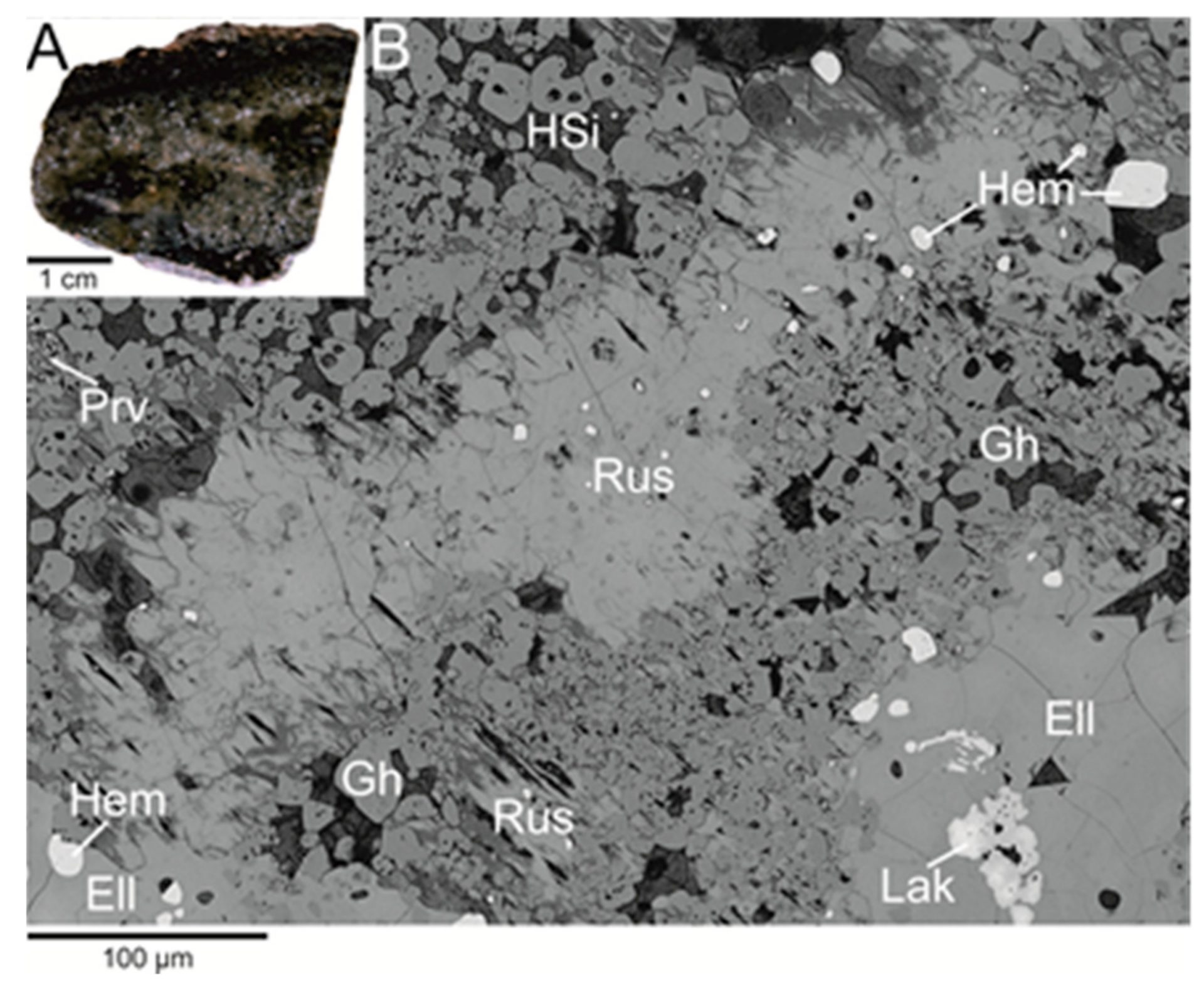
Figure 3. (A) Macroscopic photo of vein containing rusinovite from the Bellerberg volcano, Caspar quarry; (B) BSE image of rusinovite. Ell—ellestadite, Gh—gehlenite, Hem—hematite, HSi—unidentified secondary Ca-silicates; Lak—lakargiite; Prv—perovskite, Rus—rusinovite. — Photo: Środek, D.; Juroszek, R.; Krüger, H.; Krüger, B.; Galuskina, I.; Gazeev, V. · CC BY 4.0
Rusinovite
Rusinovite is an IMA-recognized mineral species in the silicate class, with the chemical formula Ca₁₀(Si₂O₇)₃Cl₂.
It crystallizes in the orthorhombic crystal system (space group Cmcm).
Key properties: Mohs hardness 4–5; specific gravity 2.93; White streak; Vitreous to silky luster; optically biaxial.
IMA symbol Rnv, IMA status: approved, named in 2010.
Found in a thermally altered (sanidinite facies) carbonate-silicate xenolith about 10 m in size enclosed in ignimbrite.
It is found associated with Wadalite, wollastonite, trabzonite, rankinite, larnite.
The mineral was named to honor Vladimir L. Rusinov (1935-2007), a Russian petrologist who studied the thermodynamics of non-equilibrium mineral systems.