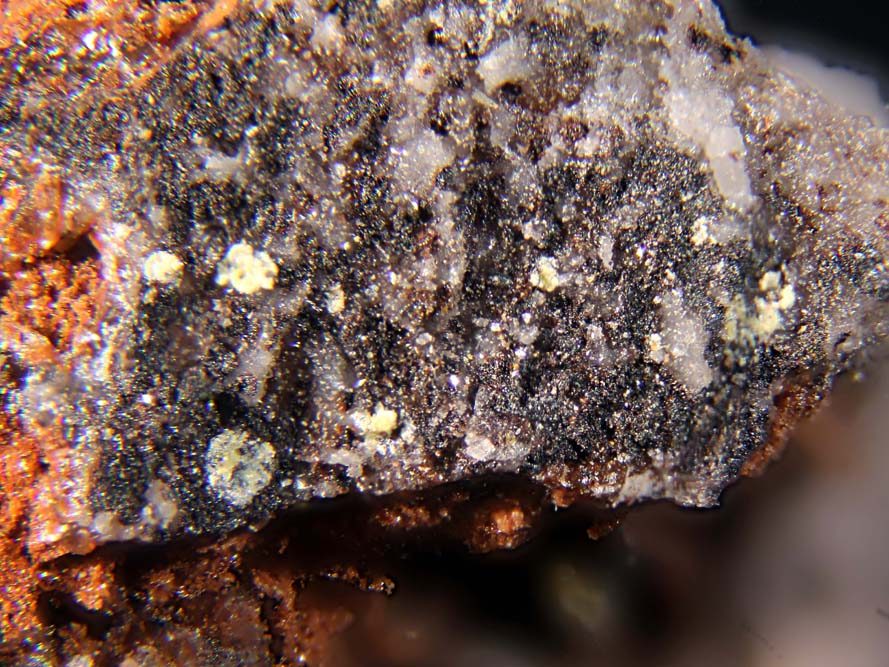
Yellow globular aggregates of the rare wolfram mineral russellite from the famous Clara Mine (Wolfach, Black Forest, Baden-Württemberg, Germany). — Photo: David Hospital · CC BY-SA 4.0
Russellite
A bismuth tungstate mineral — a yellow secondary mineral of the oxidized zone of tungsten deposits.
Intro adapted from Wikipedia (CC BY-SA).
Russellite is an IMA-recognized mineral species in the tungstate class, with the chemical formula Bi₂WO₆.
It crystallizes in the orthorhombic crystal system (space group I4_1/amd).
Key properties: Mohs hardness 3.5; specific gravity 7.35; refractive index 2.346; optically biaxial.
IMA symbol Rll, grandfathered status — known before the IMA’s founding, named in 1938.
An alteration product of earlier bismuth minerals in Sn–W-bearing high-temperature hydrothermal mineral deposits, greisens, or granite pegmatites.
It is found associated with Bismuth, bismuthinite, bismite, wolframite, ferberite, scheelite, ferritungstite, anthoinite, mpororoite, koechlinite, cassiterite, topaz, muscovite.
The mineral was named to honor Sir Arthur Edward Ian Montagu Russell (1878–1964), British mineralogist and mineral collector, of Swallowfield Park, Berkshire, England.