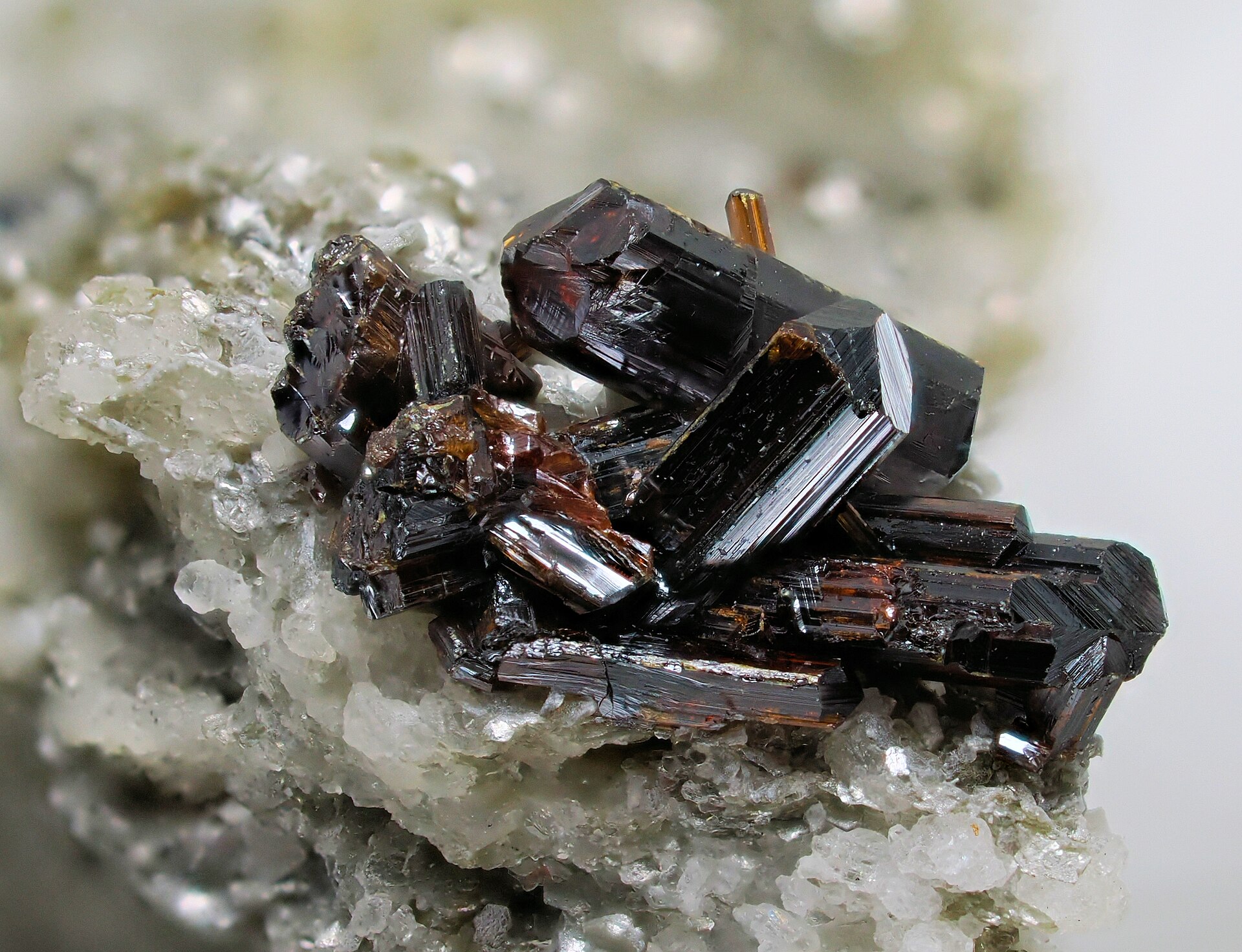
Rutile crystals on muscovite, Binntal, Valais, Switzerland. — Photo: HolDu · CC BY-SA 3.0 de
Rutile
Also known as: Titanium ore.
The commonest natural form of titanium dioxide — a major titanium ore and the golden 'needles' inside rutilated quartz.
Intro adapted from Wikipedia (CC BY-SA).
Rutile is an IMA-recognized mineral species in the oxides & hydroxide class, with the chemical formula TiO₂.
It crystallizes in the tetragonal crystal system (space group P4_2/mnm). It is a member of the Rutile structural group.
Key properties: Mohs hardness 6–6.5; specific gravity 4.23; typically brown or black or red or yellow; Pale brown, yellowish brown; gray streak; Adamantine to submetallic luster; optically uniaxial.
IMA symbol Rt, grandfathered status — known before the IMA’s founding, named in 1800.
A common high-temperature, high-pressure accessory mineral in igneous rocks, anorthosite, and granite pegmatite; in hydrothermally-altered rocks; in gneiss, schist, contact metamorphosed limestone; in clays, shales.
It is found associated with Anatase, brookite, hematite, ilmenite, apatite, adularia, albite, titanite, chlorite, pyrophyllite, calcite, quartz.
The name comes from the Latin rutilus, for red, a common color of the mineral.
Collections: Collector Favorites, Metals & Native Elements.