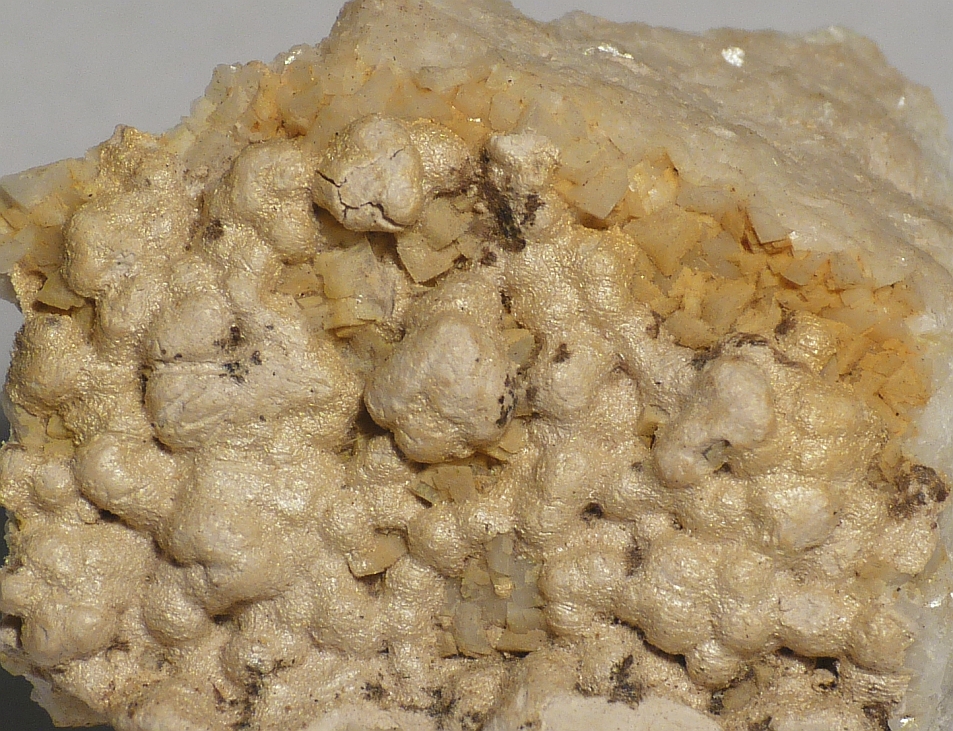
Saponite, Großer Teichelberg, Fichtelgebirge, Bavaria, Germany. — Photo: Leon Hupperichs · CC BY-SA 3.0
Saponite
Also known as: Soapstone.
A soft trioctahedral smectite clay — 'soapstone' clay — first described in 1840.
Intro adapted from Wikipedia (CC BY-SA).
Saponite is an IMA-recognized mineral species in the silicate class, with the chemical formula (Ca,Na)₀.₃(Mg,Fe)₃(Si,Al)₄O₁₀(OH)₂·4H₂O.
It is a member of the Clay, Smectite-vermiculite structural group.
Key properties: Mohs hardness 1–2; specific gravity 2.24–2.3; typically white or yellow or green or brown or gray; white streak; Greasy luster; optically biaxial.
IMA symbol Sap, grandfathered status — known before the IMA’s founding, named in 1840.
Hydrothermally deposited in mineralized veins and in vesicles in basalt. Formed in fissures cutting calc-silicates, iron-rich skarns, amphibolites, and serpentinites.
It is found associated with Celadonite, chlorite, copper, epidote, orthoclase, dolomite, calcite, quartz.
The name comes from the Latin for soap, which it resembles.
Collections: Collector Favorites.