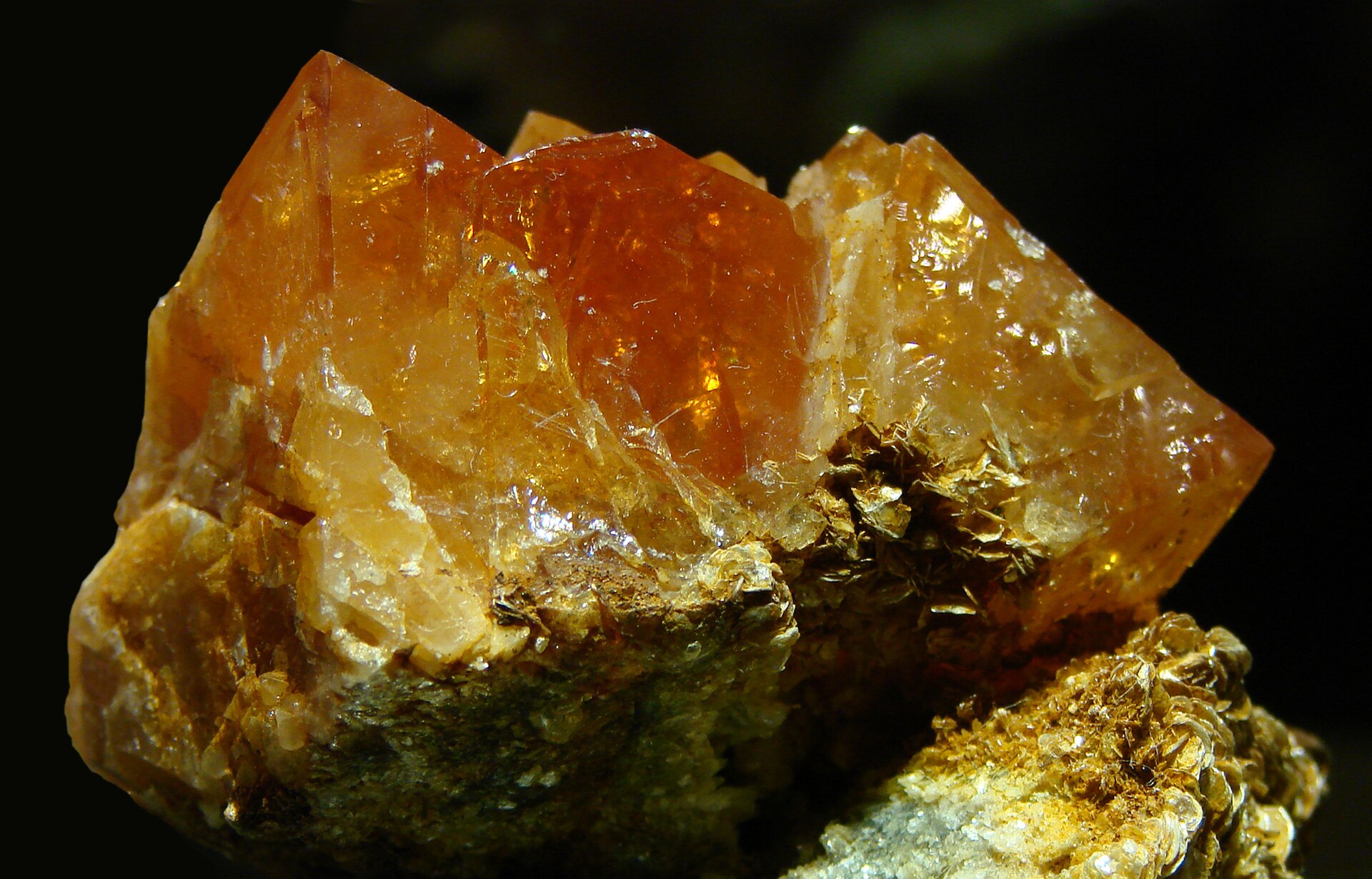
Scheelite, China. — Photo: Vassil · Public domain
Scheelite
Also known as: Tungsten ore.
Calcium tungstate — a major tungsten ore that fluoresces bright blue under UV — named for chemist Carl Wilhelm Scheele.
Intro adapted from Wikipedia (CC BY-SA).
Scheelite is an IMA-recognized mineral species in the tungstate class, with the chemical formula Ca(WO₄).
It crystallizes in the tetragonal crystal system (space group I4_1/a). It is a member of the Scheelite structural group.
Key properties: Mohs hardness 4.5–5; specific gravity 6.1; typically colorless or white or yellow or orange or brown or gray; White streak; Vitreous to adamantine luster; optically uniaxial.
IMA symbol Sch, grandfathered status — known before the IMA’s founding, named in 1821.
Typically a component of contact-metamorphic tactite; in high-temperature hydrothermal veins and greisen; less common in granite pegmatites and medium-temperature hydrothermal veins; alluvial.
It is found associated with Cassiterite, wolframite, topaz, fluorite, apatite, tourmaline, quartz (greisen); grossular–andradite, diopside, vesuvianite, tremolite (tactite).
The mineral was named to honor Karl Wilhelm Scheele (1742–1786), who determined the mineral contained tungsten.
Collections: Metals & Native Elements, Collector Favorites, Fluorescent & Glowing.