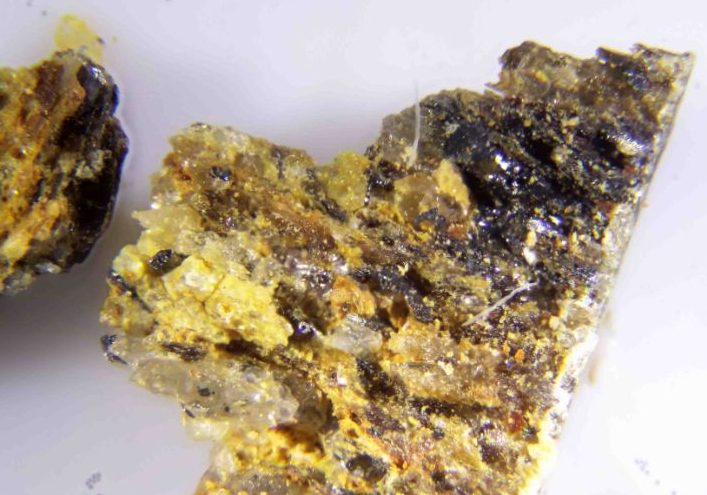
Many black berdesinskiite crystal groups associated to schreyerite from the type locality for the mineral and only one of 4 known localities worldwide. From Lasamba Hill, Kwale County, Kenya. Ex Vandenbroucke Museum collection from Waregem, Belgium. — Photo: David Hospital · CC BY-SA 4.0
Schreyerite
A vanadium-titanium oxide occurring as exsolution lamellae in rutile at Kenya's Lasamba Hill.
Intro adapted from Wikipedia (CC BY-SA).
Schreyerite is an IMA-recognized mineral species in the oxides & hydroxide class, with the chemical formula V³⁺₂Ti⁴⁺₃O₉.
It crystallizes in the monoclinic crystal system (space group C2/c). It is a member of the Schreyerite structural group.
Key properties: Mohs hardness 7; specific gravity 4.46; refractive index 2.7; optically biaxial.
IMA symbol Sry, IMA status: approved, named in 1976.
Found in quartz-biotite-sillimanite-diopside-epidote gneiss in contact with quartzite, formed above 600 ° C and 5 kbar (Lasamba Hill, Kenya); in quartzitic schists (Ol’khon Gate Straits, Lake Baikal, Russia).
It is found associated with Vanadian rutile, kornerupine, kyanite, sillimanite, muscovite, apatite, tourmaline, graphite, pyrrhotite, chalcopyrite, pentlandite (Lasamba Hill, Kenya).
The mineral was named to honor Dr. Werner Schreyer (1930–), Professor of Mineralogy, Ruhr University, Bochum, Germany.