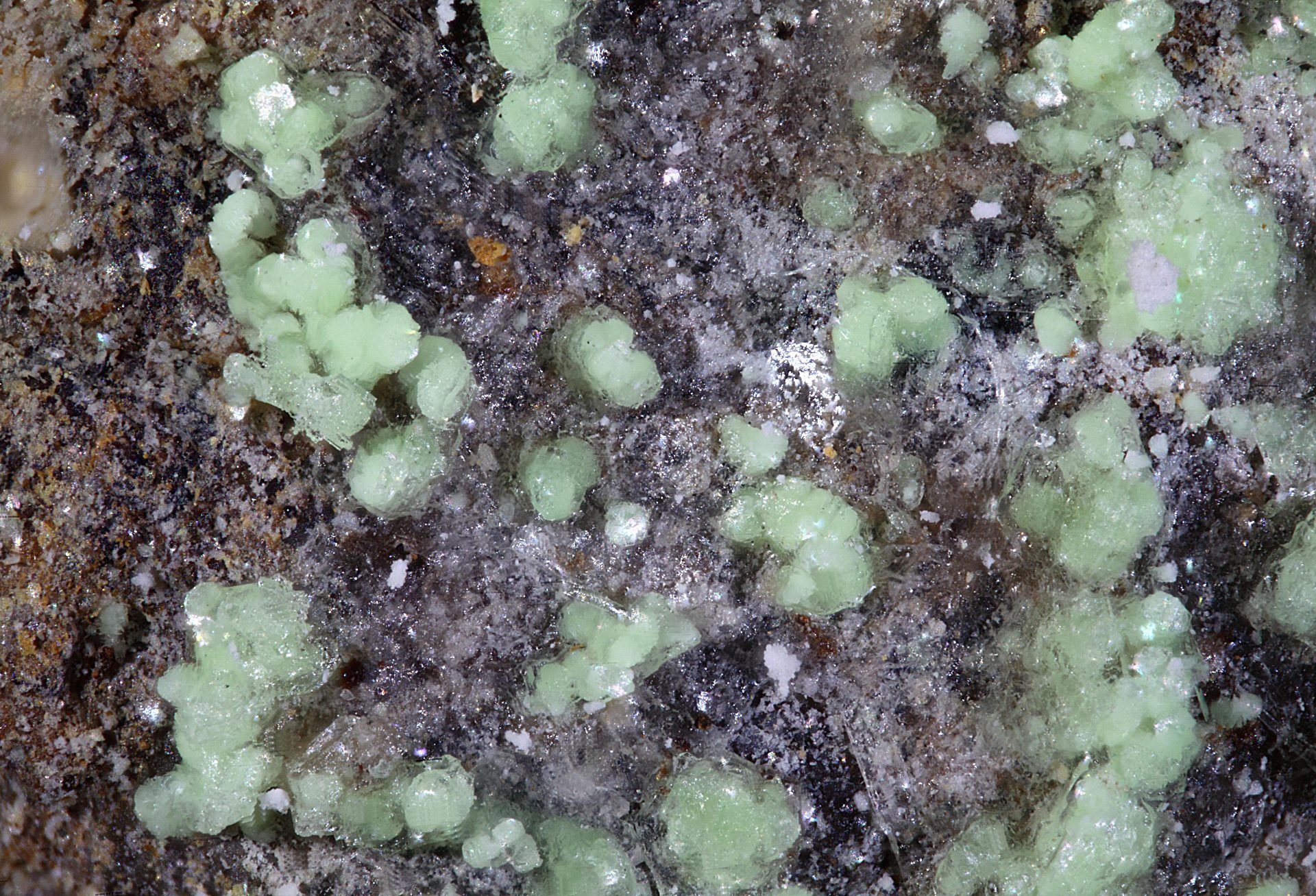
Palegreen aggregates of foliated schröckingerite crystals with colourless aggregates of hexahydrite coated with colourless, transparent gypsum from Rožná dump, shaft Bukov 2, Vysočina region, Moravia, Czech Republic (Field of view: 5.8 mm) — Photo: BLFrank · CC BY-SA 4.0
Schröckingerite
A radioactive yellow uranium carbonate-sulfate-fluoride that fluoresces yellow-green under UV.
Intro adapted from Wikipedia (CC BY-SA).
Schröckingerite is an IMA-recognized mineral species in the sulfate class, with the chemical formula NaCa₃(UO₂)(SO₄)(CO₃)₃F·10H₂O.
It crystallizes in the triclinic crystal system (space group P-1).
Key properties: Mohs hardness 2.5; specific gravity 2.54–2.55; Subvitreous, pearly on {001} luster; optically biaxial.
IMA symbol Srö, grandfathered status — known before the IMA’s founding, named in 1873.
An uncommon alteration product of uraninite in the oxidized zone of uranium deposits; may be of post-mine origin.
It is found associated with Gypsum, andersonite, bayleyite, swartzite, albrechtschraufite, liebigite, uraninite, dolomite.
The mineral was named to honor Julius Schröckinger von Neudenberg (1813–1882), Austrian geologist who originally found the mineral at Jáchymov, Czech Republic.