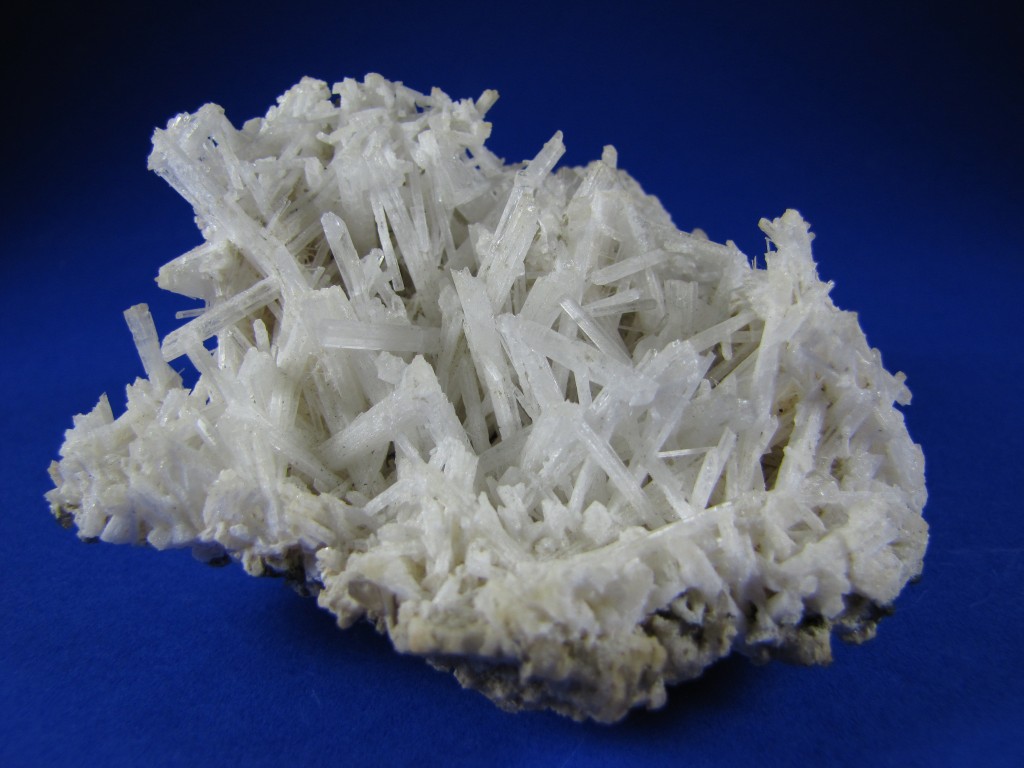
Scolecite (Size: 9 x 6 x 9 cm) Locality: Sattelkar, Gosskopf, Obersulzbach valley, Hohe Tauern, Salzburg, Austria Original description: A cluster of well positi — Photo: Gerd Stefanik · Public domain
Scolecite
A calcium zeolite forming radiating white needles — companion to natrolite and mesolite in basalt cavities.
Intro adapted from Wikipedia (CC BY-SA).
Scolecite is an IMA-recognized mineral species in the silicate class, with the chemical formula Ca(Si₃Al₂)O₁₀·3H₂O.
It crystallizes in the monoclinic crystal system (space group Fd). It is a member of the Natrolite structural group.
Key properties: Mohs hardness 5–5.5; specific gravity 2.25–2.29; typically white or colorless or pink; white streak; Vitreous, silky when fibrous luster; refractive index 1.516; optically biaxial.
IMA symbol Slc, IMA status: approved, named in 1813.
Primarily in cavities in basalts; in gneisses and amphibolites, and in laccoliths and dikes derived from syenitic and gabbroic magmas.
It is found associated with Zeolites, prehnite, calcite.
Its name comes from the Greek for worm, alluding to its curling action when heated.
Collections: Collector Favorites.