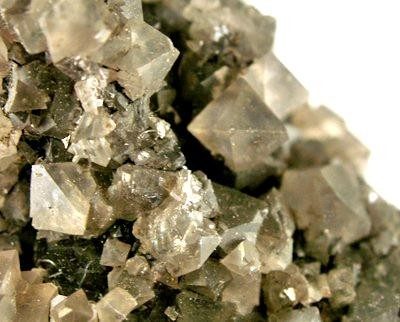
Sénarmontite Locality: Djebel Haminate Mine, Ain Beida , Constantine Province , Algeria ( Locality at mindat.org ) Size: 5.5 x 3.3 x 1.8 cm. Senarmontite is an uncommon antimony oxide and this excellent, rich specimen is from the Type Locality in Algeria - the Djebel Haminate Mine. Sharp, waxy lustre, translucent, gray senarmontite octahedrons to 6 mm cover all three sides of the 3-dimensional massive senarmontite matrix. This is a rare species, and these old specimens were found by the old French exploration service BRGM, prior to the 1950s and even as far back as the 1850s. Odds are that this was one of the specimens found on one of those French expeditions. You seldom see any examples of this species in crystalline form except from this locality, and from here usually just thumbnail loose crystals. This is a remarkable, large, matrix specimen. Ex. John Ydren Collection. — Photo: Robert M. Lavinsky · CC BY-SA 3.0
Senarmontite
Antimony(III) oxide is the inorganic compound with the formula Sb2O3. It is the most important commercial compound of antimony. It is found in nature as the minerals valentinite and senarmontite. A mixed arsenic-antimony oxide occurs in nature as the very rare mineral stibioclaudetite.
Intro adapted from Wikipedia (CC BY-SA).
Senarmontite is an IMA-recognized mineral species in the oxides & hydroxide class, with the chemical formula Sb₂O₃.
It crystallizes in the cubic crystal system (space group Fd3m). It is a member of the Arsenolite structural group.
Key properties: Mohs hardness 2–2.5; specific gravity 5.5; White streak; Resinous to subadamantine luster.
IMA symbol Sen, IMA status: approved, named in 1851.
produced through oxidation of antimony, stibnite, and other antimony minerals in hydrothermal antimony-bearing deposits.
It is found associated with Valentinite, kermesite, stibiconite, cetineite, mopungite, sulfur.
The mineral was named to honor Henri Hureau de Sénarmont (1808–1862), French physicist and mineralogist, School of Mines, Paris, France, who first noted the species.