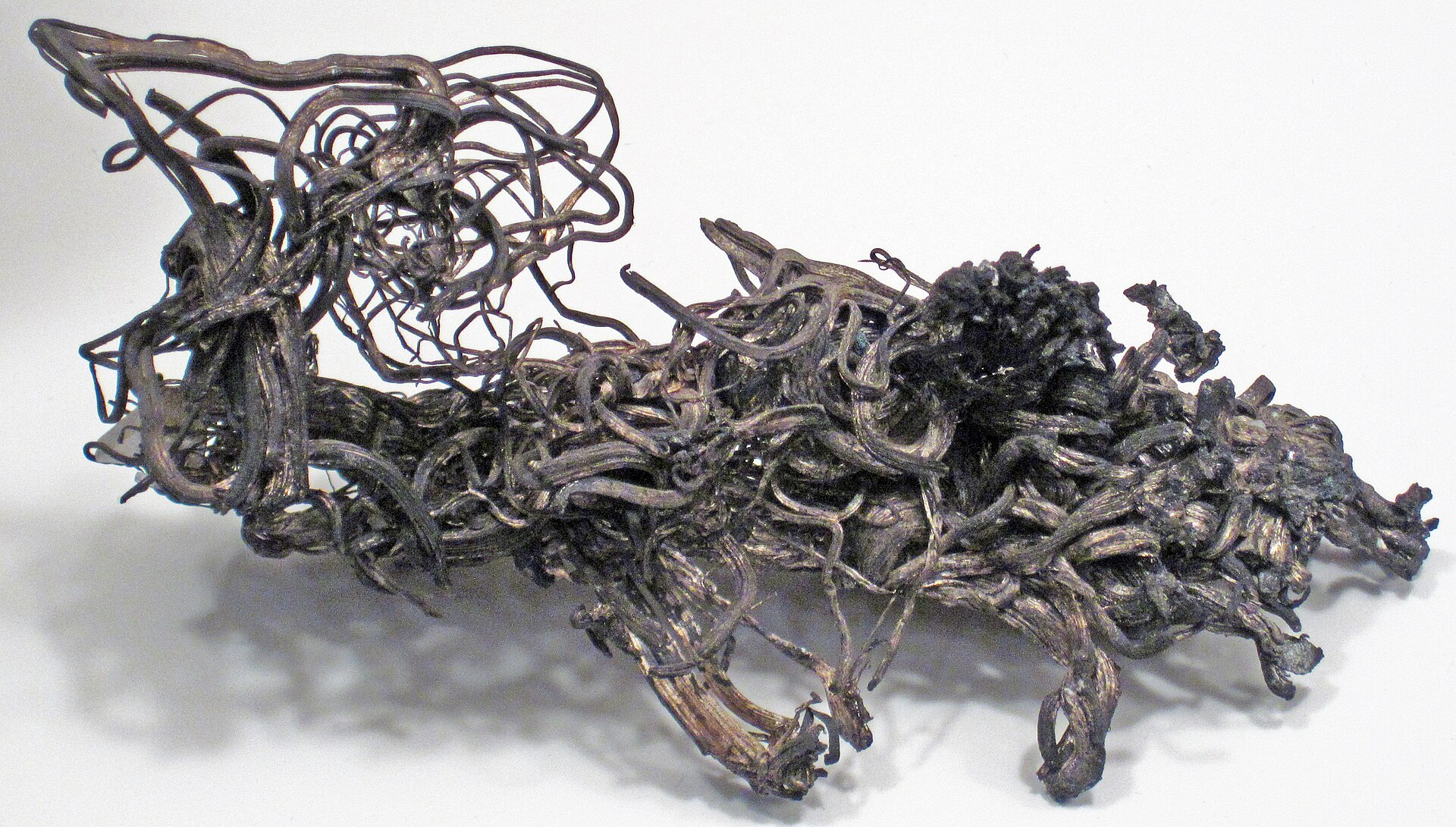
Silver wire from Kazakhstan. (public display, Carnegie Museum of Natural History, Pittsburgh, Pennsylvania, USA) A mineral is a naturally-occurring, solid, inor — Photo: James St. John · CC BY 2.0
Silver
Also known as: Native silver, Wire silver.
The whitest metal (symbol Ag, atomic number 47) — the best electrical conductor, and a classic native element mineral.
Intro adapted from Wikipedia (CC BY-SA).
Silver is an IMA-recognized mineral species in the native element class, with the chemical formula Ag.
It crystallizes in the cubic crystal system (space group Fm3m). It is a member of the Copper structural group.
Key properties: Mohs hardness 2.5–3; specific gravity 10.1–11.1; typically gray or white or black; Silver-white streak; Metallic. R: (400) 83.4, (420) 84.5, (440) 86.0, (460) 87.7, (480) 89.1, (500) 90.5, (520) 91.8, (540) 93.0 luster.
IMA symbol Ag, grandfathered status — known before the IMA’s founding.
A primary hydrothermal mineral, also formed by secondary processes, especially in the oxidized portions of mineral deposits.
It is found associated with Acanthite, chlorargyrite, embolite, silver sulfosalts, gold, copper.
The name comes from an Old English word for the metal soelfer, related to the German silber and the Dutch zilver; the chemical symbol from the Latin argentum.
Collections: Metals & Native Elements, Collector Favorites.