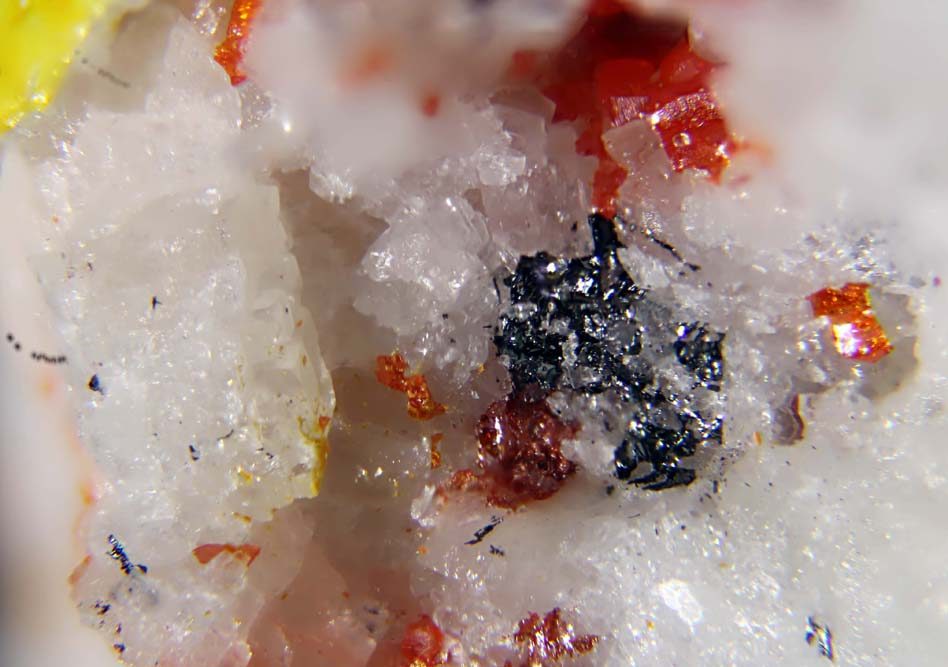
Bronze colored crystals of the extremely rare thallium mineral imhofite, associated to the also rare red wine smithite and realgar. From: Lengenbach Quarry, Binntal, Wallis, Switzerland. The number of confirmed imhofite specimens worldwide until 2002 was only 120 (all of them in Lengenbach, of course). Find of 1974. Imhofite is one of the rarest and most sought after thallium minerals from Lengenbach, in part due to its name related to the family Imhof, very famous in the whole Binntal. — Photo: David Hospital · CC BY-SA 4.0
Smithite
A silver-arsenic sulfosalt described in 1905 from the Lengenbach quarry, named for British Museum's Herbert Smith.
Intro adapted from Wikipedia (CC BY-SA).
Smithite is an IMA-recognized mineral species in the sulfosalt class, with the chemical formula AgAsS₂.
It crystallizes in the monoclinic crystal system (space group A2/a).
Key properties: Mohs hardness 1.5–2; specific gravity 4.88; Vermilion streak; Adamantine luster; optically biaxial.
IMA symbol Sth, grandfathered status — known before the IMA’s founding, named in 1905.
Of hydrothermal origin with other Ag–As sulfides.
It is found associated with Sphalerite, pyrite, realgar, orpiment, hutchinsonite, sartorite, rathite (Binntal, Switzerland); chabournéite, pierrotite, parapierrotite, stibnite, pyrite.
In honor of George Frederick Herbert Smith (1872–1953), crystallographer of the British Museum (Natural History), London, England.