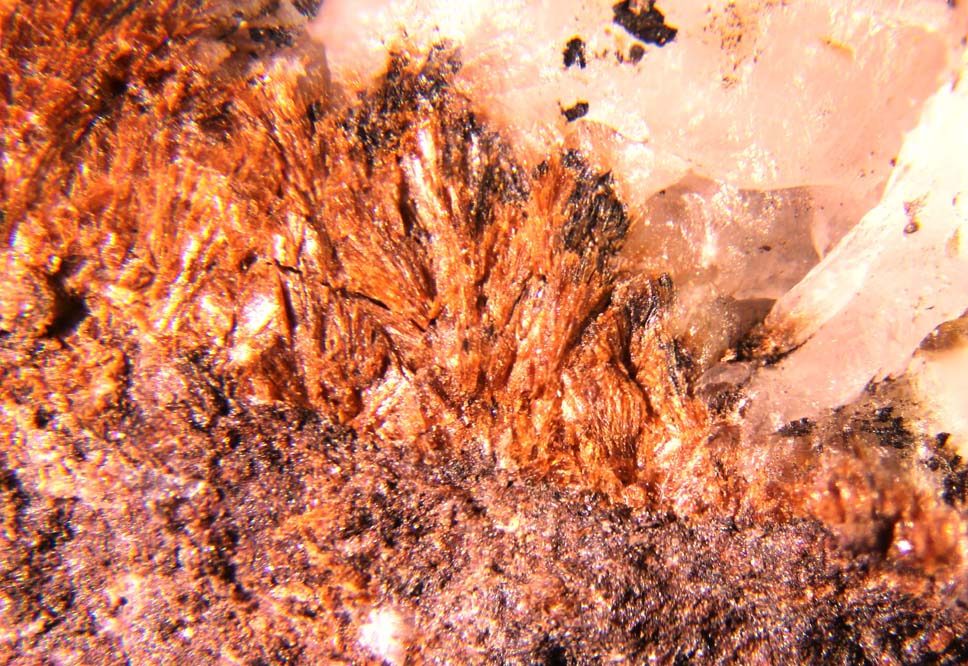
Dark orange crystals of the rare manganese mineral sursassite from a Swiss locality (Falotta, Tinzen, Grischun, Switzerland) very close to the type locality. — Photo: David Hospital · CC BY-SA 4.0
Sursassite
A manganese sorosilicate of metamorphosed manganese deposits, discovered in 1926 in Switzerland's Sursass district.
Intro adapted from Wikipedia (CC BY-SA).
Sursassite is an IMA-recognized mineral species in the silicate class, with the chemical formula Mn²⁺₂Al₃(SiO₄)(Si₂O₇)(OH)₃.
It crystallizes in the monoclinic crystal system (space group P2_1/m). It is a member of the Ardennite structural group.
Key properties: Mohs hardness 3; specific gravity 3.256; refractive index 1.745; optically biaxial.
IMA symbol Ss, grandfathered status — known before the IMA’s founding, named in 1926.
Occurs as vein fillings in manganese deposits in low-grade metasediments.
It is found associated with Braunite, barite, calcite, quartz.
The name comes from the Roman name for Oberhalbstein, Sursass, Switzerland.