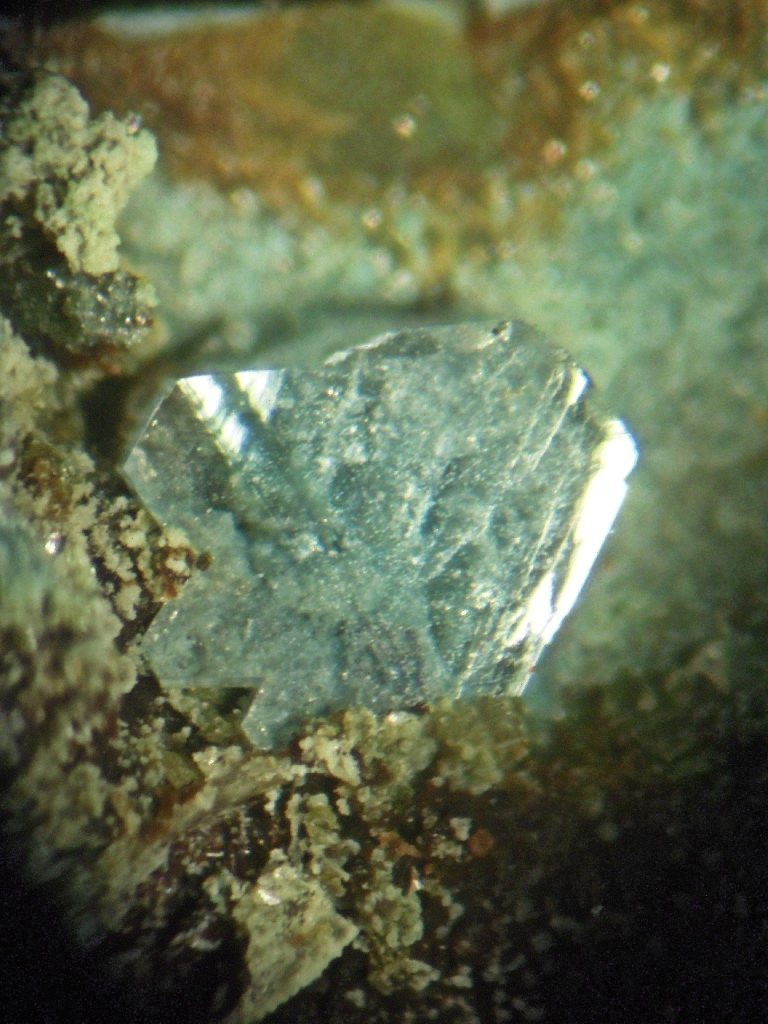
Susannite Locality: Lautenthal smelter (slag locality), Lautenthal, Harz, Lower Saxony, Germany Original description: dimension area mm. 4 x 4 — Photo: Luigi Chiappino · CC BY-SA 3.0
Susannite
A lead sulfate-carbonate that forms above 80 °C in oxidizing lead ores — the high-temperature partner of leadhillite.
Intro adapted from Wikipedia (CC BY-SA).
Susannite is an IMA-recognized mineral species in the sulfate class, with the chemical formula Pb₄(SO₄)(CO₃)₂(OH)₂.
It crystallizes in the hexagonal crystal system (space group P3).
Key properties: Mohs hardness 2.75; specific gravity 6.52; refractive index 1.96; optically uniaxial.
IMA symbol Sus, grandfathered status — known before the IMA’s founding, named in 1845.
A rare secondary mineral found in the oxidized zone of hydrothermal lead-bearing deposits, formed at temperatures above 80 ° C.
It is found associated with Leadhillite, macphersonite, lanarkite, caledonite, cerussite (Leadhills, Scotland).
The name refers to its first-noted occurrence in the Susanna mine, Leadhills, Scotland.