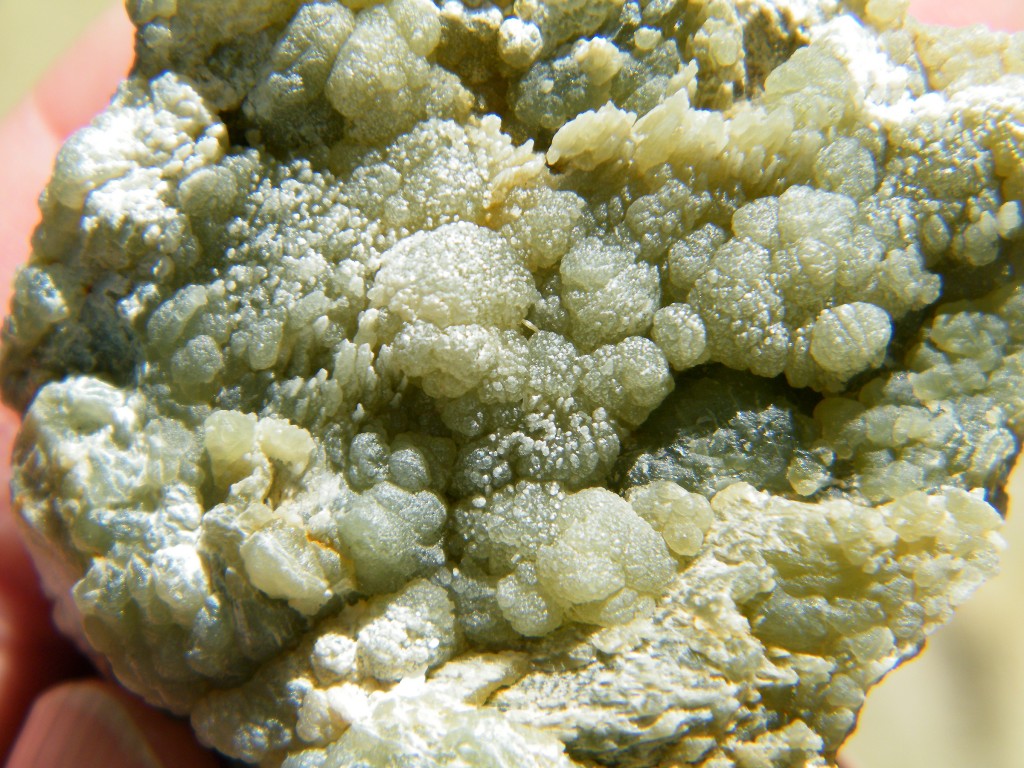
Botryoidal Talc (Dimensions: about 2" across; 2" x 2" x 2" specimen) Locality: Pietranera, Rovegno, Genova Province, Liguria, Italy — Photo: John Krygier · Public domain
Talc
Also known as: Soapstone, Steatite.
The softest mineral on the Mohs scale — hydrated magnesium silicate that powders into talcum.
Intro adapted from Wikipedia (CC BY-SA).
Talc is an IMA-recognized mineral species in the silicate class, with the chemical formula Mg₃Si₄O₁₀(OH)₂.
It crystallizes in the triclinic crystal system (space group C-1). It is a member of the Clay, Talc structural group.
Key properties: Mohs hardness 1; specific gravity 2.58–2.83; typically white or gray or green or colorless; White streak; Pearly, greasy, dull luster; refractive index 1.577; optically biaxial.
IMA symbol Tlc, grandfathered status — known before the IMA’s founding.
Found in talc-rich schists or steatite through hydrothermal alteration of mafic rocks (steatitization) subsequent to serpentinization during greenschist facies metamorphism.
It is found associated with Actinolite, tremolite, chlorite, pyroxene, vermiculite, serpentine, anthophyllite, dolomite, calcite.
Probably from the Arabic talq.
Collections: Everyday Minerals.