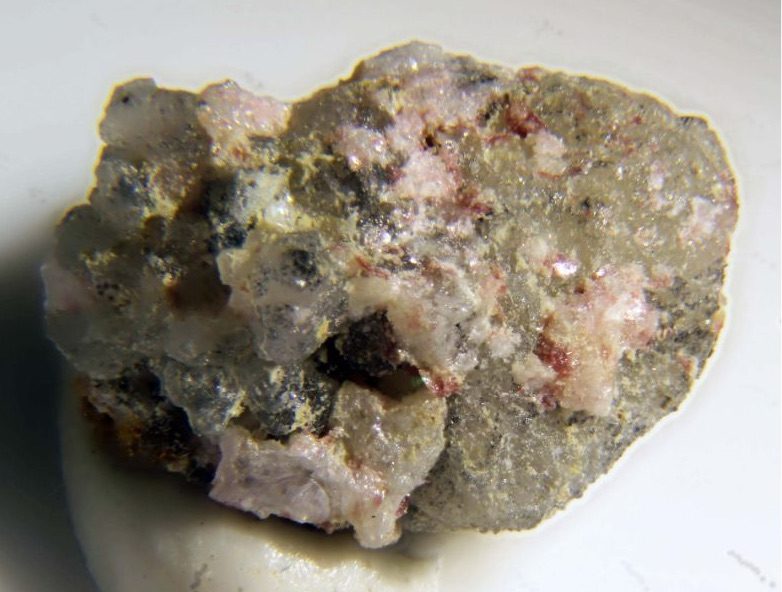
Deep pink microcrystals of the extremely rare thérèsemagnanite associated to pale pink crystals of guarinoite from the only known locality worldwide for theresemagnanite and one of the two known localities for guarinoite worldwide: Cap Garonne Mine, Le Pradet, Var, Provence-Alpes-Cote d'Azur, France. Both minerals are two of the most sought after species from Cap Garonne. Both species are Co-Zn-Ni sulphates with different ratios of Co-Zn-Ni and described in 1993 . Theresemagnanite has more cobalt, so its color it's deeper pinkish, and it is then possible to differenciate from guarinoite, that is pale pink. Ex Vandenbroucke Museum collection from Waregem, Belgium — Photo: David Hospital · CC BY-SA 4.0
Thérèsemagnanite
Thérèsemagnanite is an IMA-recognized mineral species in the sulfate class, with the chemical formula NaCo₄(SO₄)(OH)₆Cl·6H₂O.
It crystallizes in the hexagonal crystal system. It is a member of the Ktenasite structural group.
Key properties: specific gravity 2.52; Pale pink streak; Pearly luster; optically uniaxial.
IMA symbol Tmg, IMA status: approved, named in 1991.
Found as a secondary mineral in the oxidized portions of a polymetallic sulfide deposit.
It is found associated with Anglesite, antlerite, cobaltoan-nickeloan ktenasite, cerussite, brochantite, covellite, tennantite, gersdorffite, guarinoite, rutile, quartz.
The mineral was named to honor Thérèse Magnan (1918–), Toulon, France, former mathematics teacher, and President of the Association of Friends of the Mine of Cap Garonne.