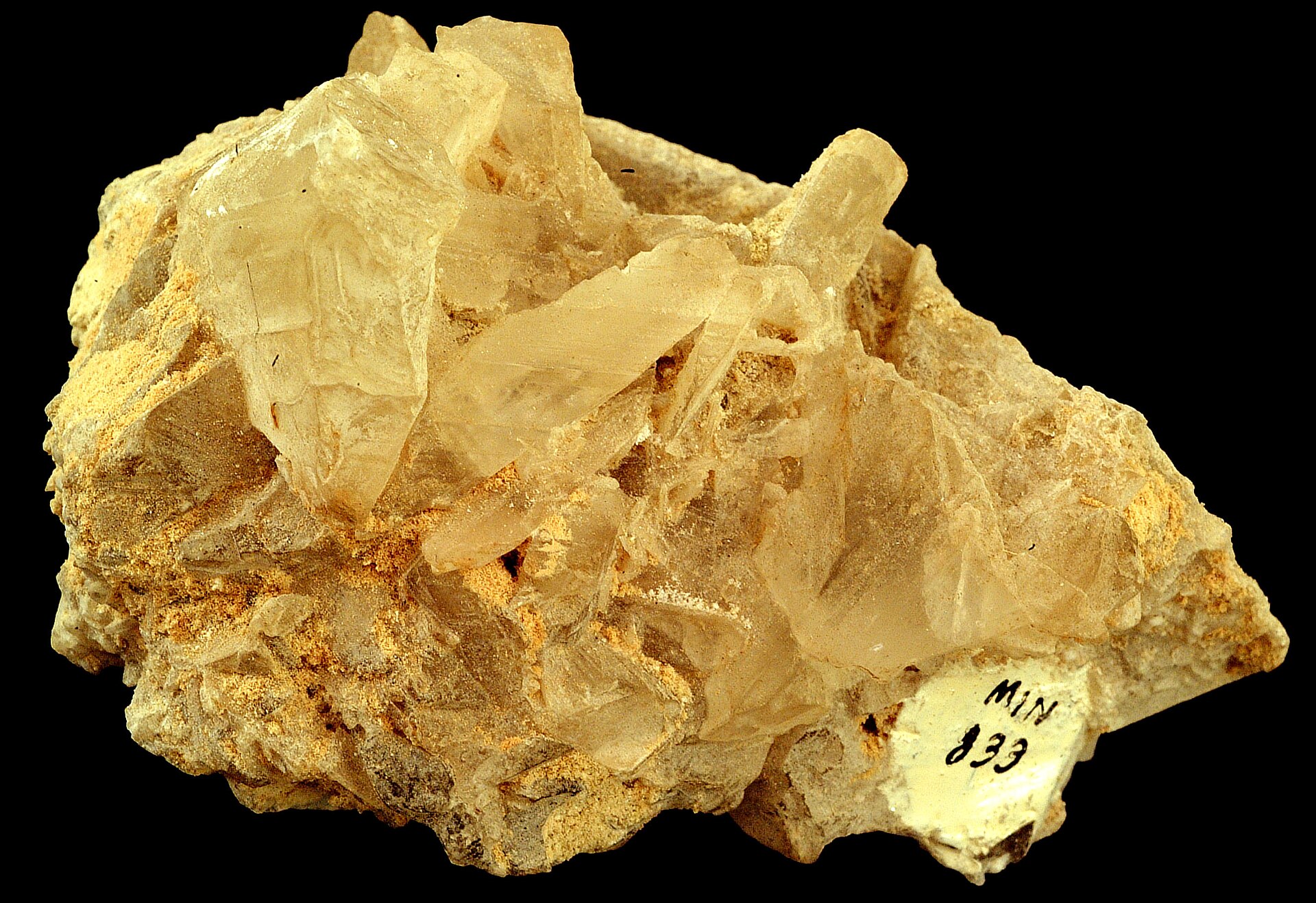
Thenardite, Na2SO4, is one of the many evaporite minerals found at Searles Lake (a mostly dry playa) in California, USA. It easily dissolves in water and so is — Photo: Darla Sondrol · CC0
Thénardite
Anhydrous sodium sulfate — a white evaporite of desert playas and fumarole crusts.
Intro adapted from Wikipedia (CC BY-SA).
Thénardite is an IMA-recognized mineral species in the sulfate class, with the chemical formula Na₂(SO₄).
It crystallizes in the orthorhombic crystal system (space group Fddd).
Key properties: Mohs hardness 2.5–3; specific gravity 2.664; typically white or colorless or gray or brown or yellow; white streak; Vitreous to resinous luster; refractive index 1.477; optically biaxial.
IMA symbol Thn, IMA status: approved, named in 1826.
is typically found in lacustrine (salt and soda lake) evaporite deposits in arid regions, also as crusts and efflorescences, which may be ephemeral, in a wide range of geologic environments; as precipitates around fumaroles.
It is found associated with Mirabilite, blödite, glauberite, epsomite, gypsum, natron, halite.
The mineral was named to honor Professor Louis Jacques Thénard (1777–1857), French chemist, University of Pierre and Marie Curie, Paris, France.
Collections: Collector Favorites.