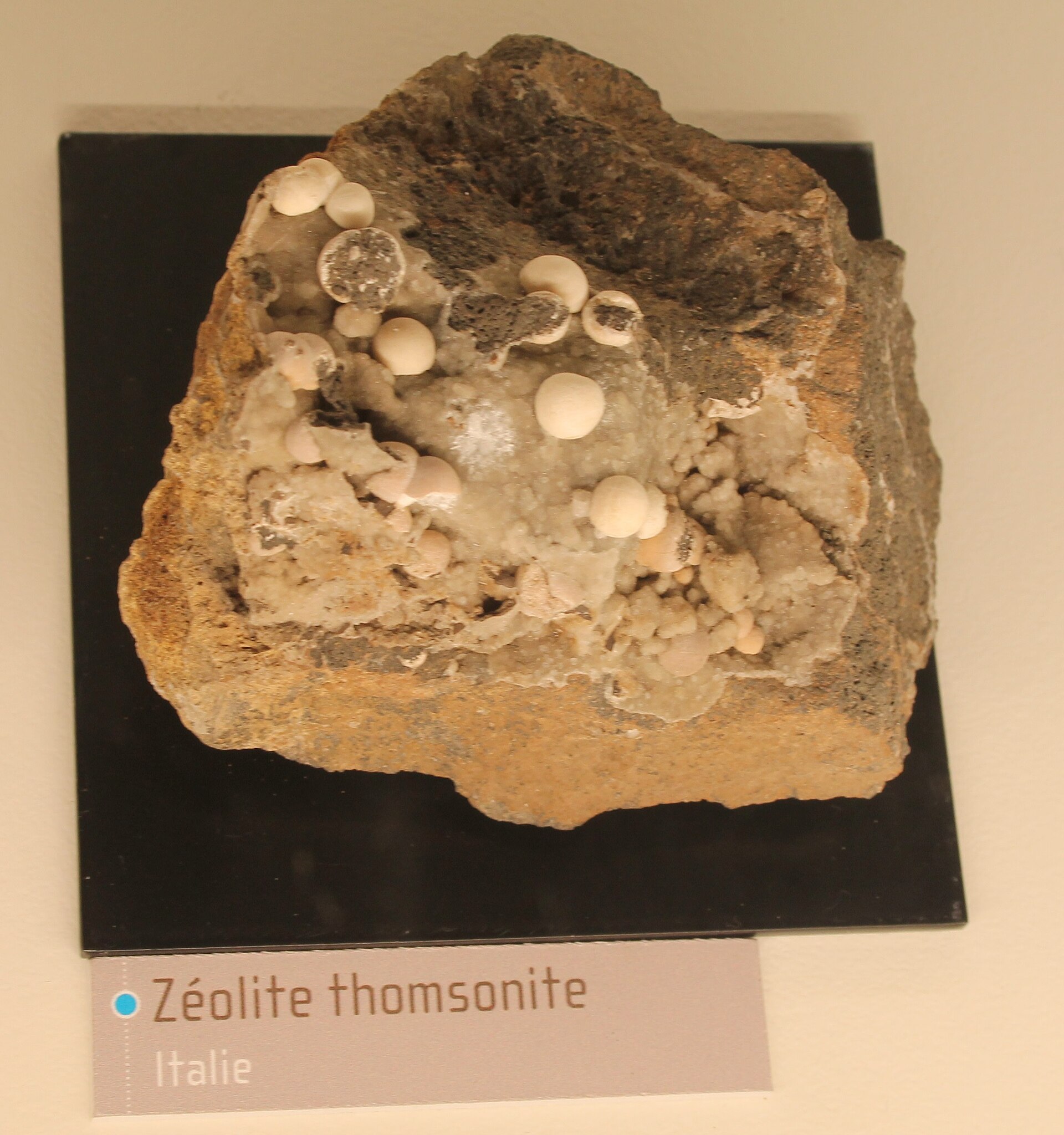
Zéolite thomsonite, en provenance d'Italie, au Muséum de Nantes — Photo: Koreller · CC BY-SA 4.0
Thomsonite-Ca
Also known as: Thomsonite.
The calcium member of the thomsonite zeolite pair — radial 'eyes' and needles in basalt cavities.
Intro adapted from Wikipedia (CC BY-SA).
Thomsonite-Ca is an IMA-recognized mineral species in the silicate class, with the chemical formula NaCa₂(Al₅Si₅)O₂₀·6H₂O.
It crystallizes in the orthorhombic crystal system (space group Pbmn). It is a member of the Thomsonite structural group.
Key properties: Mohs hardness 5–5.5; specific gravity 2.23–2.39; typically white or pink or brown or green; White streak; Vitreous to pearly luster; optically biaxial.
IMA symbol Thm-Ca, IMA status: approved, named in 1820.
Found in amygdules and fractures in mafic igneous rocks, typically basalts; in some alkalic igneous rocks, contact metamorphic zones, and hypabyssal rocks. An authigenic cement in some sandstones.
It is found associated with Zeolites, calcite, prehnite, datolite, quartz.
The name refers to Dr. Thomas Thomson (1773-1852), Scottish chemist and mineralogist of Glasgow, Scotland, who first analyzed the mineral. Suffix indicates the Ca-dominant member of the series.
Collections: Collector Favorites.