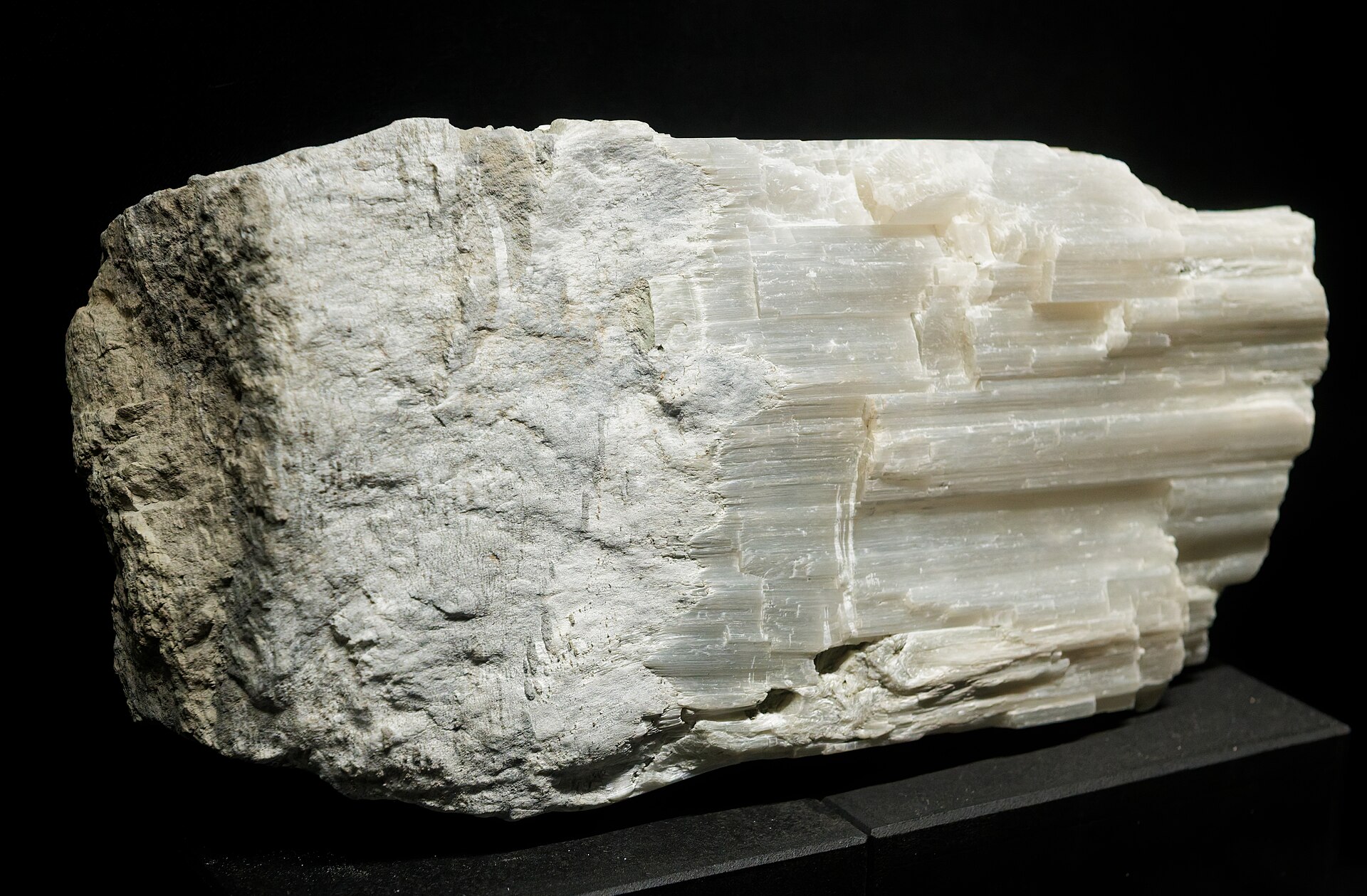
Ulexite from Boron, California, USA. Sorbonne University mineral collection. — Photo: Marie-Lan Taÿ Pamart · CC BY 4.0
Ulexite
Also known as: TV rock, Television stone.
The 'TV stone' — a sodium-calcium borate whose parallel fibers pipe an image to the surface.
Intro adapted from Wikipedia (CC BY-SA).
Ulexite is an IMA-recognized mineral species in the borate class, with the chemical formula NaCaB₅O₆(OH)₆·5H₂O.
It crystallizes in the triclinic crystal system (space group P-1).
Key properties: Mohs hardness 2.5; specific gravity 1.955; typically white or colorless; white streak; Vitreous; silky or satiny in fibrous aggregates luster; refractive index 1.506; optically biaxial.
IMA symbol Ulx, grandfathered status — known before the IMA’s founding, named in 1850.
is typically found in playa and salt-marsh deposits in arid regions and bedded sedimentary deposits formed from these, the boron supplied from surrounding hot springs. Some occurrences contain upwards of one billion tons of ulexite.
It is found associated with Colemanite, borax, meyerhofferite, hydroboracite, probertite, glauberite, trona, mirabilite, calcite, gypsum, halite.
The mineral was named to honor George Ludwig Ulex (1811–1883), German chemist who obtained the first reliable analysis of the mineral.
Collections: Collector Favorites.