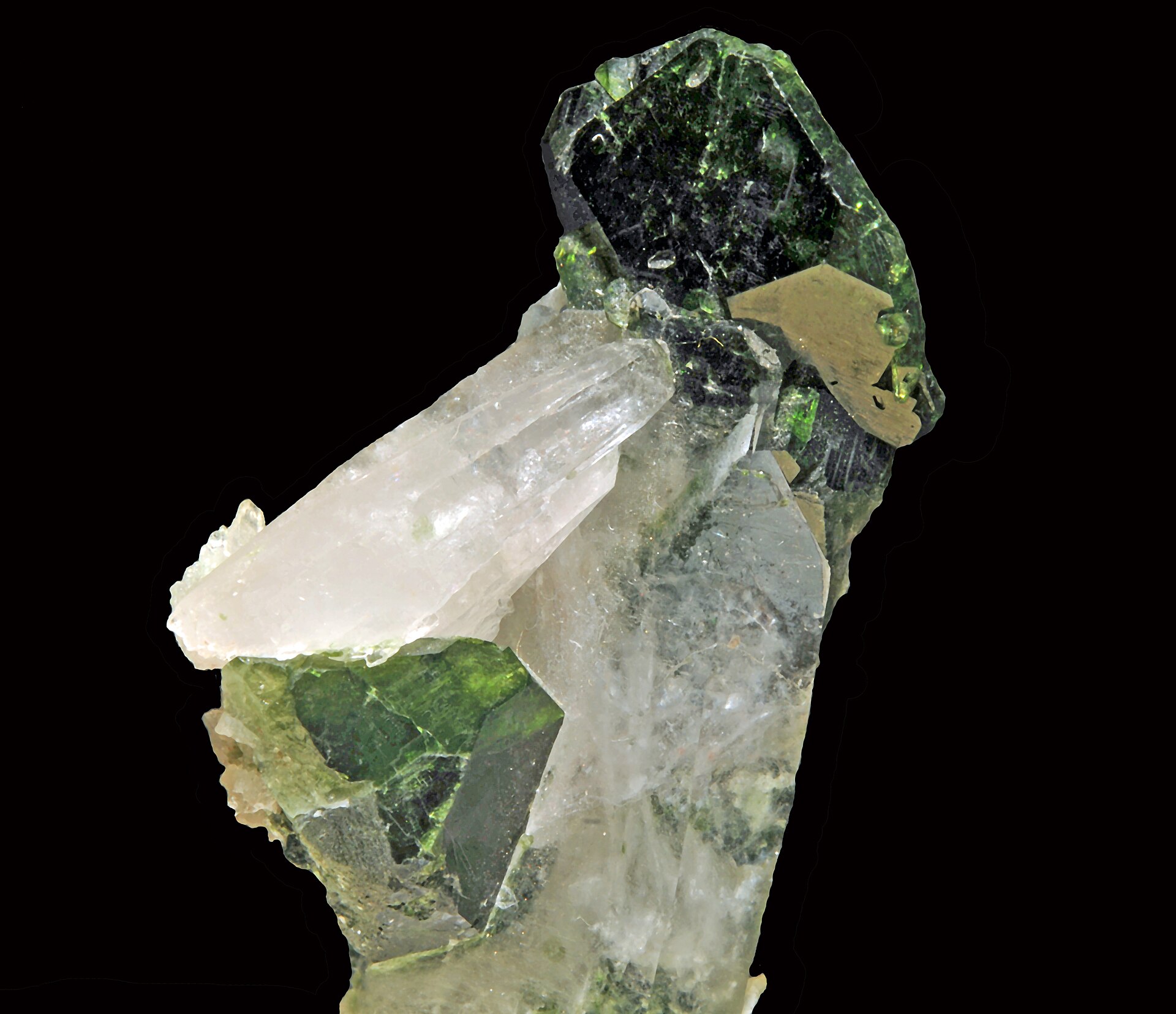
crystals of tourmaline var. uvite, crystals of quartz : Pomba pit, Serra das Éguas, Brumado (Bom Jesus dos Meiras), Bahia, Brazil — Photo: Parent Géry · CC BY-SA 3.0
Uvite
A calcium-magnesium tourmaline with dominant hydroxyl — red, green or brown crystals in contact-metamorphic rocks.
Intro adapted from Wikipedia (CC BY-SA).
Uvite is an IMA-recognized mineral species in the silicate class, with the chemical formula CaMg₃(Al₅Mg)(Si₆O₁₈)(BO₃)₃(OH)₃(OH).
It crystallizes in the hexagonal crystal system (space group R3m). It is a member of the Tourmaline structural group.
Key properties: Mohs hardness 7.5; specific gravity 2.97–3.14; typically brown or green or black or red; White, light green, light brown streak; Vitreous to resinous luster; optically uniaxial.
IMA symbol Uvt, IMA status: approved, named in 2000.
is typically found in calcium-rich rocks sub jected to contact metamorphism and metasomatic processes which added boron.
It is found associated with Calcite, dolomite, tremolite, apatite, scapolite.
The name refers to the occurrence in Uva Province, Sri Lanka.
Collections: Collector Favorites.