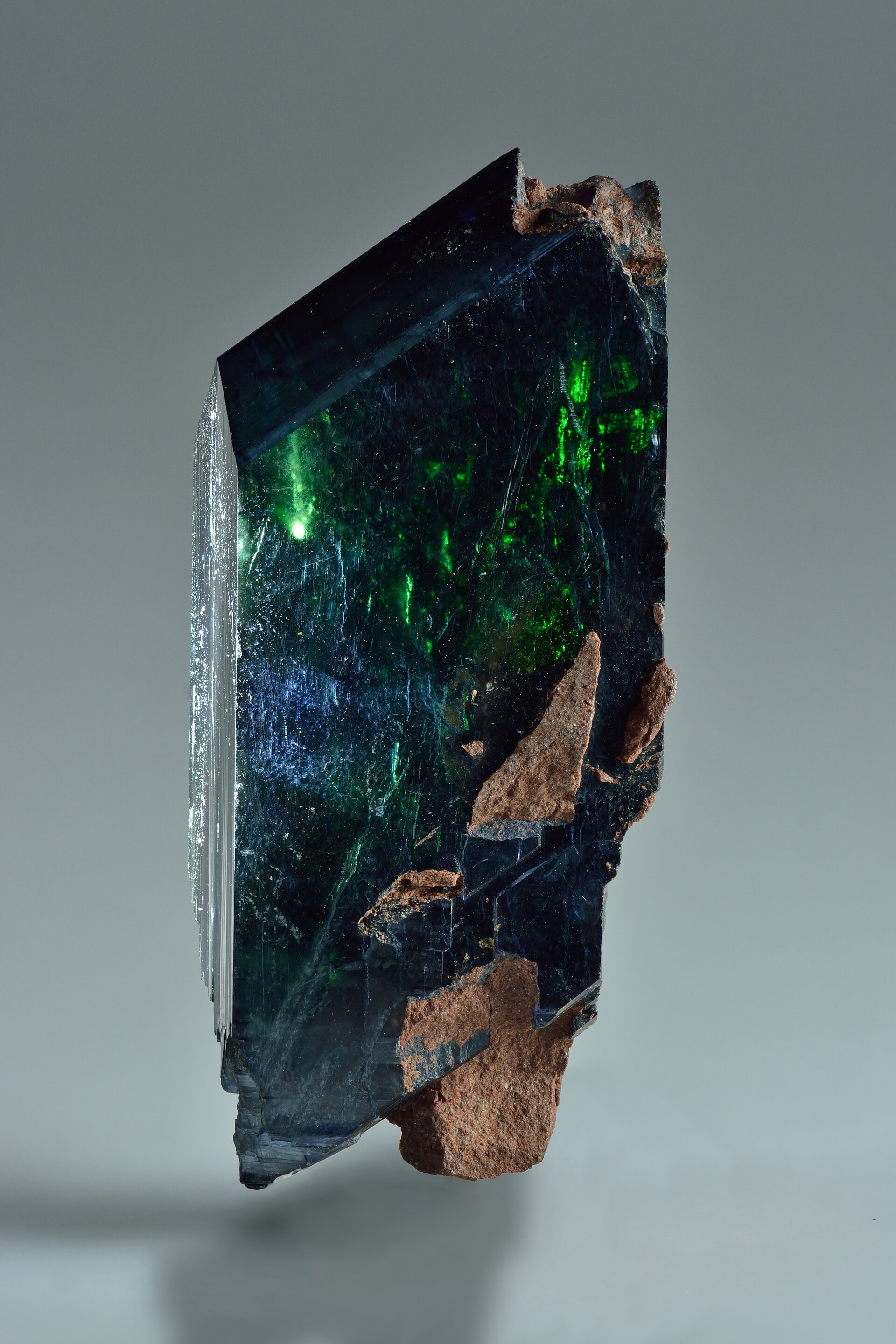
Deep green double terminated vivianite crystal (4.0 × 1.7 × 1.7 cm). Found from Tomokoni mine, Canutillos subdistrict, Machacamarca mining district, Cornelio Sa — Photo: Ivar Leidus · CC BY-SA 4.0
Vivianite
Also known as: Blue iron earth.
A hydrated ferrous phosphate — colorless when fresh, darkening to blue-green as it oxidizes; the 'blue iron' of bogs and fossils.
Intro adapted from Wikipedia (CC BY-SA).
Vivianite is an IMA-recognized mineral species in the phosphate class, with the chemical formula Fe²⁺₃(PO₄)₂·8H₂O.
It crystallizes in the monoclinic crystal system (space group C2/m). It is a member of the Vivianite structural group.
Key properties: Mohs hardness 1.5–2; specific gravity 2.68; typically green or blue or colorless; White, altering to dark blue, brown streak; Vitreous, pearly on the cleavage, dull when earthy luster; refractive index 1.626; optically biaxial.
IMA symbol Viv, grandfathered status — known before the IMA’s founding, named in 1817.
Found as a secondary mineral in the oxidized zone of metallic ore deposits and complex granite pegmatites; replacing organic material in fossil bones, lake sediments, and in bog-iron ores and peat bogs; rarely in caves.
It is found associated with Metavivianite, ludlamite, pyrite, pyrrhotite.
The mineral was named to honor John Henry Vivian (1785–1855), Welsh-Cornish mineralogist, of Truro, Cornwall, England, who discovered the species.
Collections: Collector Favorites.