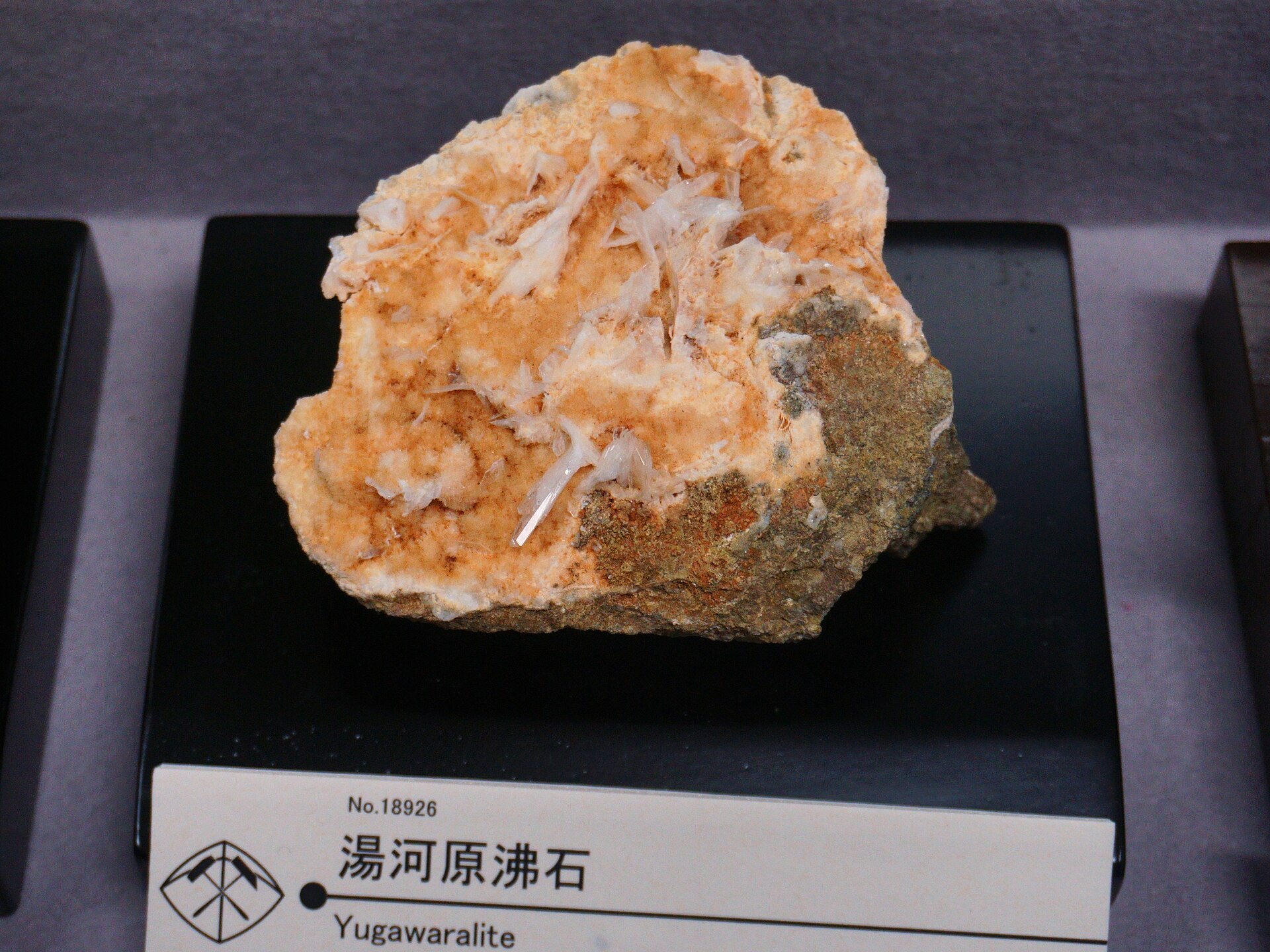
Yugawaralite exhibited at the Mining Museum of Akita University — Photo: 掬茶 · CC BY-SA 4.0
Yugawaralite
A clear-to-pink calcium zeolite described in 1952 from the Yugawara hot springs, Japan.
Intro adapted from Wikipedia (CC BY-SA).
Yugawaralite is an IMA-recognized mineral species in the silicate class, with the chemical formula Ca(Si₆Al₂)O₁₆·4H₂O.
It crystallizes in the monoclinic crystal system.
Key properties: Mohs hardness 4.5–5; specific gravity 2.2–2.23; typically colorless or white or yellow; White streak; Vitreous to pearly, iridescent on {010}. Streak: White luster; optically biaxial.
IMA symbol Yug, IMA status: approved, named in 1952.
Occurs as crystals lining cavities, and veinlets, typically deposited in active geothermal areas.
It is found associated with Zeolites, gyrolite, okenite, prehnite, quartz, calcite.
The name is derived from the locality where first found, Yugawara Hot Spring, Japan.
Collections: Collector Favorites, Rare & Remarkable.