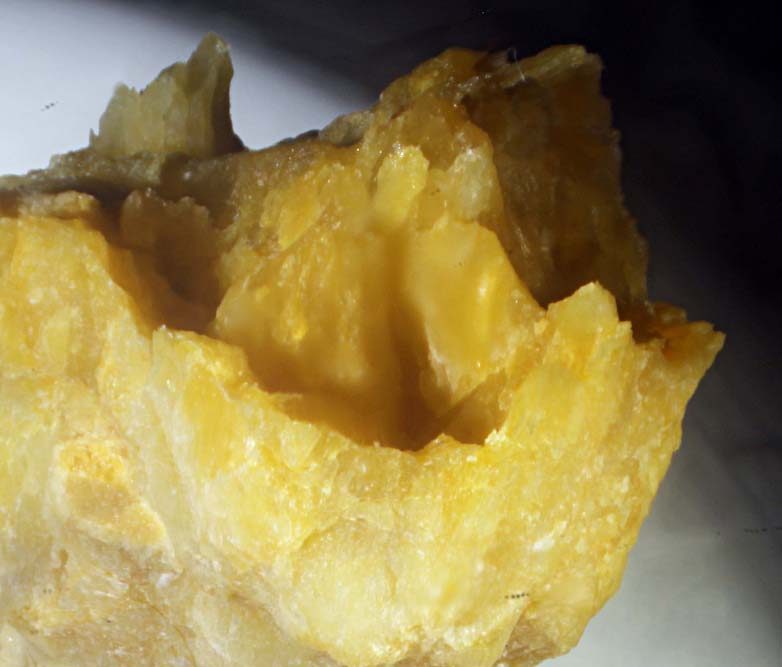
Yellow crystal aggregates of the rare sulphate mineral zaherite from one of the only three known localities worldwide: Hotson 6 Mine, Koenabib Farm, Bushmanland, North Cape Province, South Africa. — Photo: David Hospital · CC BY-SA 4.0
Zaherite
A complex hydrated aluminium sulfate discovered in 1977 in Pakistan's Salt Range.
Intro adapted from Wikipedia (CC BY-SA).
Zaherite is an IMA-recognized mineral species in the sulfate class, with the chemical formula Al₁₂(SO₄)₅(OH)₂₆·20H₂O.
It crystallizes in the triclinic crystal system.
Key properties: Mohs hardness 3.5; specific gravity 2.01; Pearly to earthy luster; optically biaxial.
IMA symbol Zah, IMA status: approved, named in 1977.
Found in veinlets in a kaolinite-böhmite rock (Punjab Salt Range, Pakistan); an alteration product of natroalunite or directly by hydrothermal sulfatization of sillimanite in massive sillimanite veins (Hotson farm, South Africa).
It is found associated with Kaolinite, böhmite, aluminite (Punjab Salt Range, Pakistan); natroalunite, hotsonite (Hotson farm, South Africa).
In honor of Mohammed Abduz Zaher (1935–), Geological Survey of Bangladesh, who discovered the mineral.