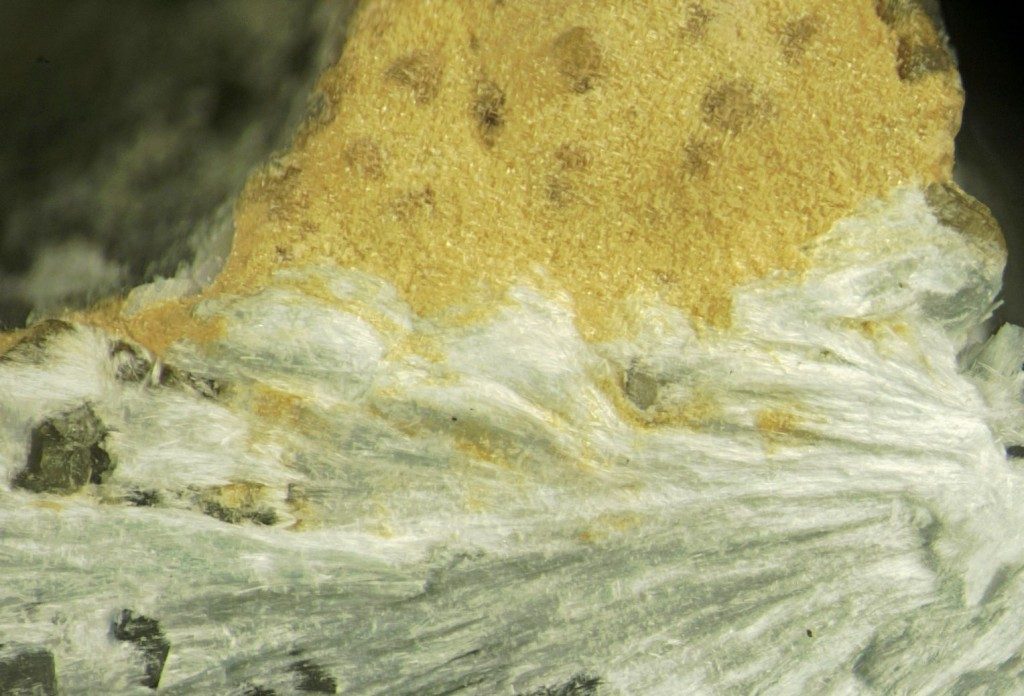
Makatite , Zakharovite Locality: Demix-Varennes quarry, Saint-Amable sill, Varennes & St-Amable, Lajemmerais RCM, Montérégie, Québec, Canada Field of view: ~6½ x 4⅓ mm. Description: Fibrous makatite with a hint of the “sea green” color characteristic of this find associazted with “mustard” – zakharovite. Found Sept 2000. MOB coll. It can be very difficult to distinguish zakharovite from “smectite group” at STA but in this case the “flake size” seems too large for the more powdery smectite. However, even under high magnification I only see a very few xls with hexagonal shape – perhaps wishful thinking. The dark areas in the makatite are natrolite terminations trying to push through. The dark spots in the “mustard” are something else. Close inspection shows rounded red/brown blobs. I don’t know what they are. This material is from a hydrothermalite with (relatively) abundant varennesite. — Photo: Modris Baum · Public domain
Zakharovite
A yellow pearly sodium-manganese silicate discovered in 1982 on the Kola Peninsula.
Intro adapted from Wikipedia (CC BY-SA).
Zakharovite is an IMA-recognized mineral species in the silicate class, with the chemical formula Na₄Mn²⁺₅Si₁₀O₂₄(OH)₆·6H₂O.
It crystallizes in the hexagonal crystal system.
Key properties: Mohs hardness 2; specific gravity 2.58–2.64; Pearly, vitreous to dull waxy luster; optically uniaxial.
IMA symbol Zak, IMA status: approved, named in 1981.
Found in ussingite veinlets cutting foyaite in differentiated alkalic massifs (Kola Peninsula, Russia).
It is found associated with Ussingite (Kola Peninsula, Russia); terskite, lovozerite, ussingite, natrolite, microcline, yofortierite, analcime, natrolite.
The name refers to Professor Evgeii Evgen'evich Zakharov (1902–1980), Director of the Moscow Geological Exploration Institute, Moscow, Russia.