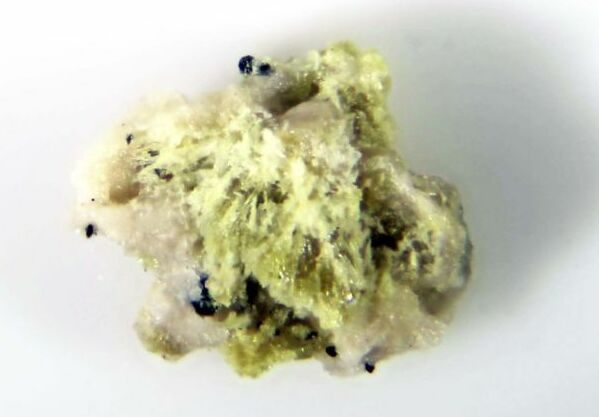
Very small yellow crystal group of the extremely rare Ca-Mn-Fe mineral zodacite from the type locality in Mangualde, Portugal (Cubos-Mesquitela-Mangualde Area, Mangualde, Viseu District, Portugal) and only one of the two known localities worldwide, in a completely analyzed specimen by SEM/EDS. Ex Vandenbroucke Museum collection from Waregem, Belgium. — Photo: David Hospital · CC BY-SA 4.0
Zodacite
Zodacite is an IMA-recognized mineral species in the phosphate class, with the chemical formula Ca₄Mn²⁺Fe³⁺₄(PO₄)₆(OH)₄·12H₂O.
It crystallizes in the monoclinic crystal system. It is a member of the Calcioferrite structural group.
Key properties: Mohs hardness 4; specific gravity 2.68; Pale yellow to white streak; Vitreous luster; optically biaxial.
IMA symbol Zod, IMA status: approved, named in 1987.
Initially found on a museum specimen from a complex zoned granite pegmatite.
It is found associated with Jahnsite-(CaMnMn), huréaulite, phosphosiderite, varulite, microcline.
The mineral was named to honor Peter Zodac (1894–1967), American founder of Rocks and Minerals magazine.