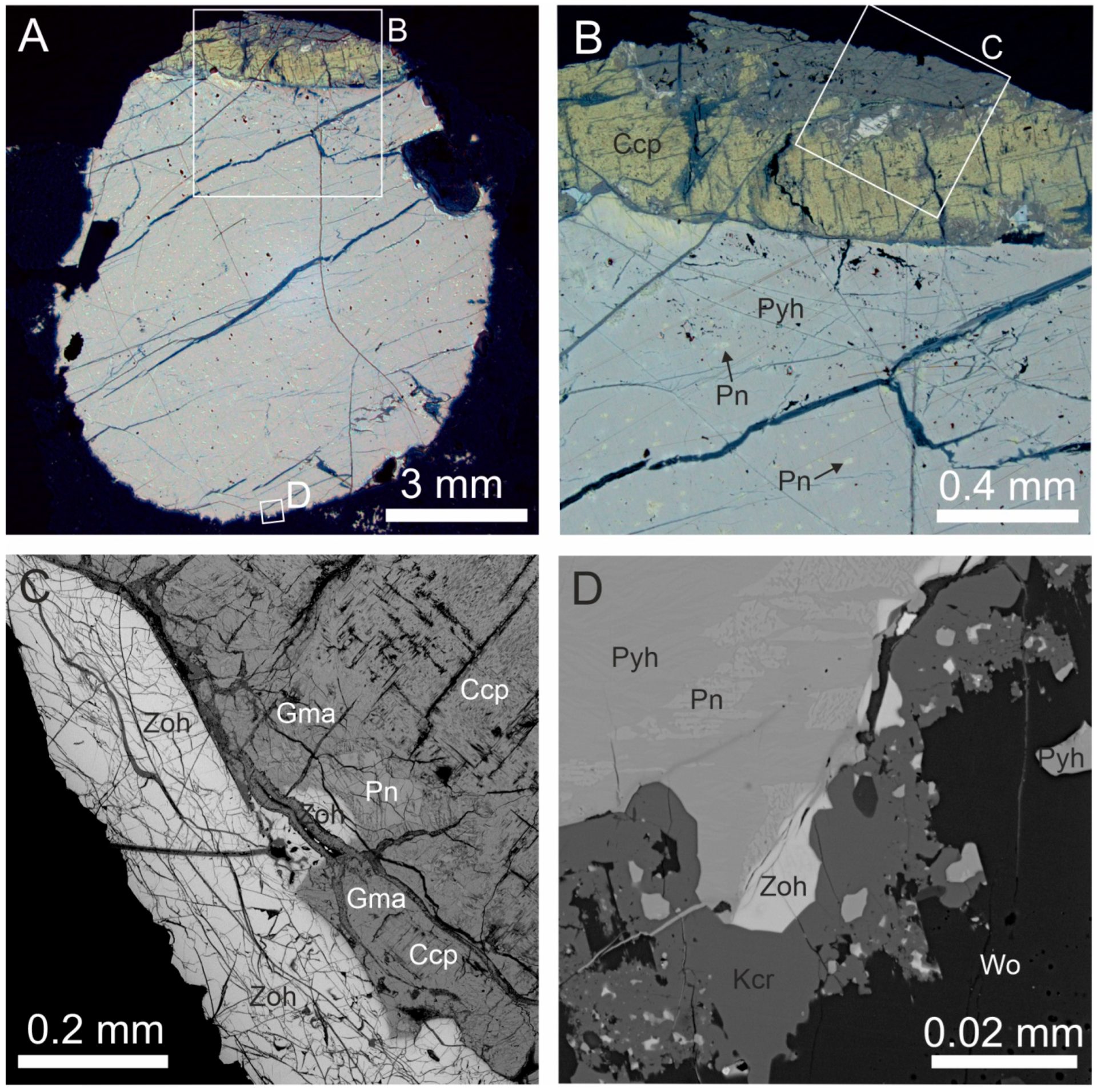
Figure 3. Zoharite, the holotype specimen. (A) Pyrrhotite nodule with chalcopyrite zone formed as a result of residual melt crystallization enriched in Cu. Reflected light. Fragments enlarged in Figure 3B,D are outlined. (B) The chalcopyrite zone on the pyrrhotite nodule is replaced by zoharite and gmalimite. Pale yellow spots of pentlandite are well visible in pyrrhotite. Reflected light. The enlarged fragment in (C) is outlined by a frame. (C) Zoharite splintered by cracks in all directions, indicating that mineral does not have cleavage. BSE image. (D) Zoharite crystals growing on the surface of pyrrhotite nodule with irregular pentlandite grains. Kirschsteinite zone forms between wollastonite and the sulfide nodule. BSE image. Ccp—chalcopyrite, Gma—gmalimite, Pn—pentlandite, Pyh—pyrrhotite, Wo—wollastonite, Zoh—zoharite, Kcr—kirschsteinite. — Photo: Galuskina, I.O.; Krüger, B.; Galuskin, E.V.; Krüger, H.; Vapnik, Y.; Murashko, M.; Banasik, K.; Agakhanov, A.A. · CC BY 4.0
Zoharite
Zoharite is an IMA-recognized mineral species in the sulfide class, with the chemical formula (Ba,K)₆(Fe,Cu,Ni)₂₅S₂₇.
It crystallizes in the cubic crystal system (space group Pm-3m). It is a member of the Djerfisherite structural group.
IMA symbol Zoh, IMA status: approved, named in 2017.