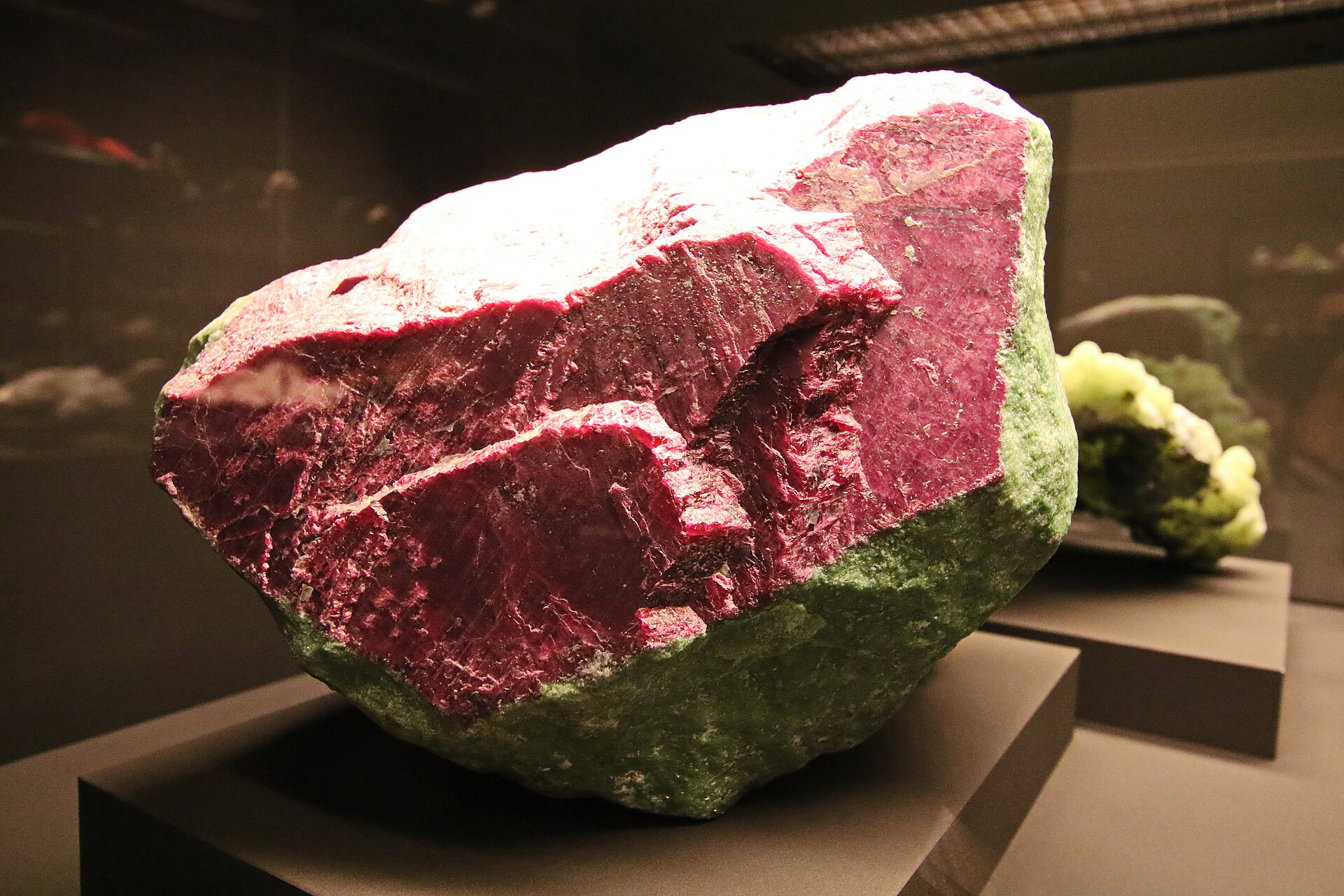
Rubin in Zoisit..Terra Mineralia. Mineralienausstellung TU Bergakademie Freiberg. — Photo: Kora27 · CC BY-SA 4.0
Zoisite
Also known as: Tanzanite (blue var.), Thulite (pink var.).
Calcium-aluminium sorosilicate — the orthorhombic mineral behind tanzanite, thulite and anyolite.
Intro adapted from Wikipedia (CC BY-SA).
Zoisite is an IMA-recognized mineral species in the silicate class, with the chemical formula Ca₂Al₃[Si₂O₇][SiO₄]O(OH).
It crystallizes in the orthorhombic crystal system (space group Pnma). It is a member of the Epidote structural group.
Key properties: Mohs hardness 6–7; specific gravity 3.15–3.36; typically green or brown or gray or blue or pink or purple; white streak; Vitreous, pearly on cleavage luster; refractive index 1.702; optically biaxial.
IMA symbol Zo, grandfathered status — known before the IMA’s founding, named in 1805.
is typically found in medium-grade regionally metamorphosed crystalline schists formed from igneous, sedimentary, or metamorphic rocks relatively high in calcium; in eclogites and blueschist facies metamorphic rocks.
It is found associated with Garnet, albite, biotite, \hornblende, " quartz, calcite.
The name refers to Siegmund Zois, Baron von Edelstein (1747–1819), Austrian supporter of mineralogy who supplied the first specimens.
Collections: Gemstones, Collector Favorites.