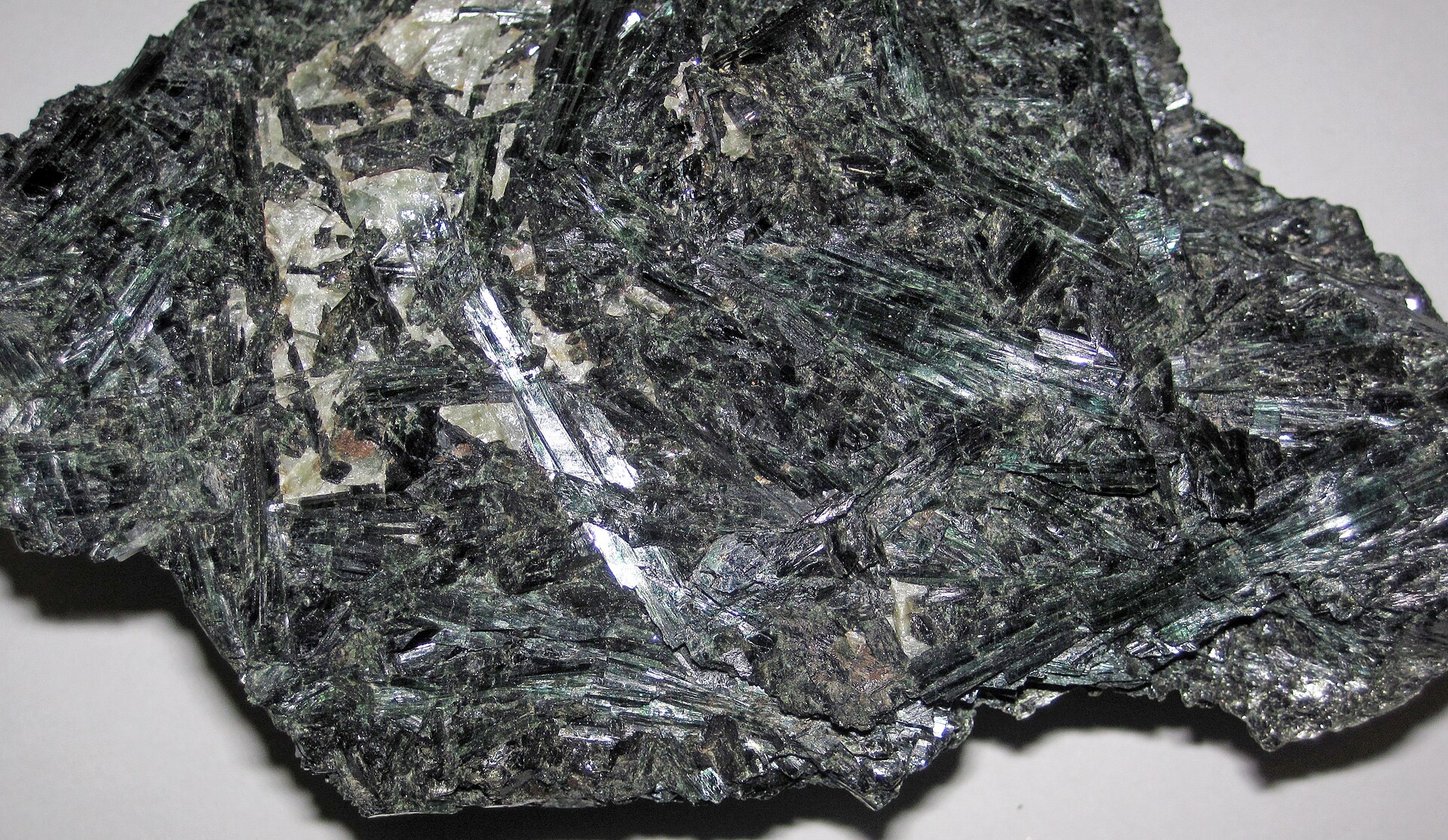
Schist is an intermediate- to high-grade, foliated metamorphic rock. It is highly variable in appearance, depending on the mineral content, which is a function — Photo: James St. John · CC BY 2.0
Actinolite
Also known as: Nephrite jade (with tremolite).
A common amphibole silicate of calcium, magnesium and iron; fibrous actinolite mixes with tremolite to form nephrite jade.
Intro adapted from Wikipedia (CC BY-SA).
Actinolite is an IMA-recognized mineral species in the silicate class, with the chemical formula Ca₂(Mg₄.₅₋₂.₅Fe²⁺₀.₅₋₂.₅)Si₈O₂₂(OH)₂.
It crystallizes in the monoclinic crystal system (space group C2/m). It is a member of the Amphibole structural group.
Key properties: Mohs hardness 5–6; specific gravity 3.03–3.24; typically green; White streak; Vitreous, silky luster; refractive index 1.634; optically biaxial.
IMA symbol Act, IMA status: approved, named in 1794.
Produced by low-grade regional or contact metamorphism of magnesium carbonate, mafic, or ultramafic rocks; also in glaucophane-bearing blueschists.
It is found associated with Talc, epidote, chlorite, glaucophane, pumpellyite, lawsonite, albite.
Its name comes from the Greek for ray, in allusion to the mineral's common radiating fibrous habit.
Collections: Everyday Minerals, Collector Favorites.