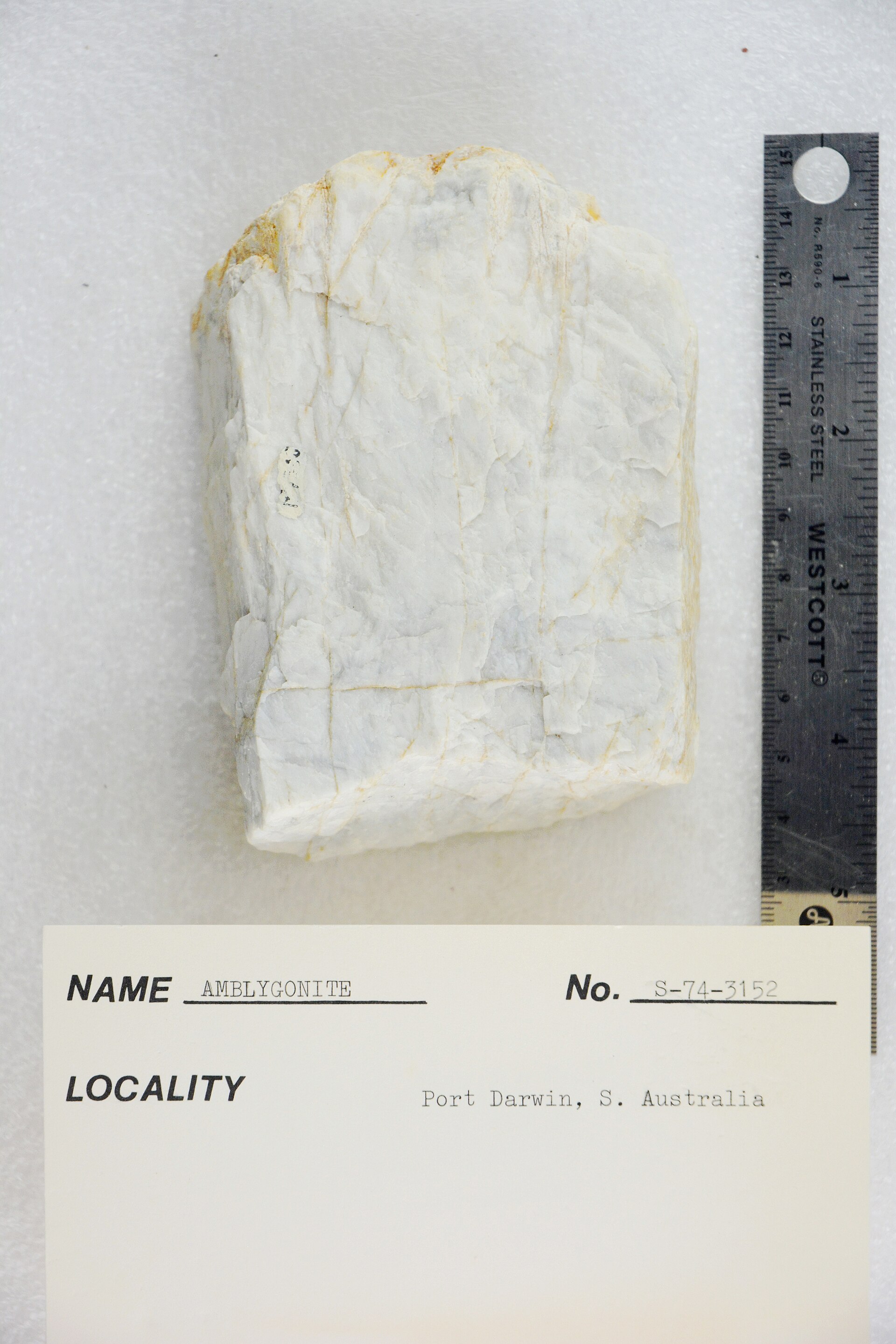
Port Darwin South Australia, Australia — Photo: Pacific Museum of Earth from Canada · CC BY-SA 2.0
Amblygonite
Amblygonite () is a fluorophosphate mineral, (Li,Na)AlPO4(F,OH), composed of lithium, sodium, aluminium, phosphate, fluoride and hydroxide. The mineral occurs in pegmatite deposits and is easily mistaken for albite and other feldspars. Its density, cleavage and flame test for lithium are diagnostic. Amblygonite forms a series with montebrasite, the low fluorine endmember. Geologic occurrence is in granite pegmatites, high-temperature tin veins, and greisens. Amblygonite occurs with spodumene, apatite, lepidolite, tourmaline, and other lithium-bearing minerals in pegmatite veins.
Intro adapted from Wikipedia (CC BY-SA).
Amblygonite is an IMA-recognized mineral species in the phosphate class, with the chemical formula LiAl(PO₄)F.
It crystallizes in the triclinic crystal system (space group C-1). It is a member of the Titanite-Amblygonite structural group.
Key properties: Mohs hardness 5.5–6; specific gravity 3.04–3.11; typically white or colorless or yellow or pink or green or blue; white streak; Vitreous to greasy, pearly on good cleavages luster; refractive index 1.596; optically biaxial.
IMA symbol Aby, grandfathered status — known before the IMA’s founding, named in 1818.
Occurs as an uncommon accessory mineral in zoned granite pegmatites; in high-temperature tin veins and greisens.
It is found associated with Lacroixite, apatite, lithiophilite, spodumene, lepidolite, petalite, pollucite, tourmaline (pegmatites); cassiterite, topaz, mica (greisens).
Its name comes from the Greek for blunt and angle, for its ∼90° cleavage angle.
Collections: Collector Favorites.