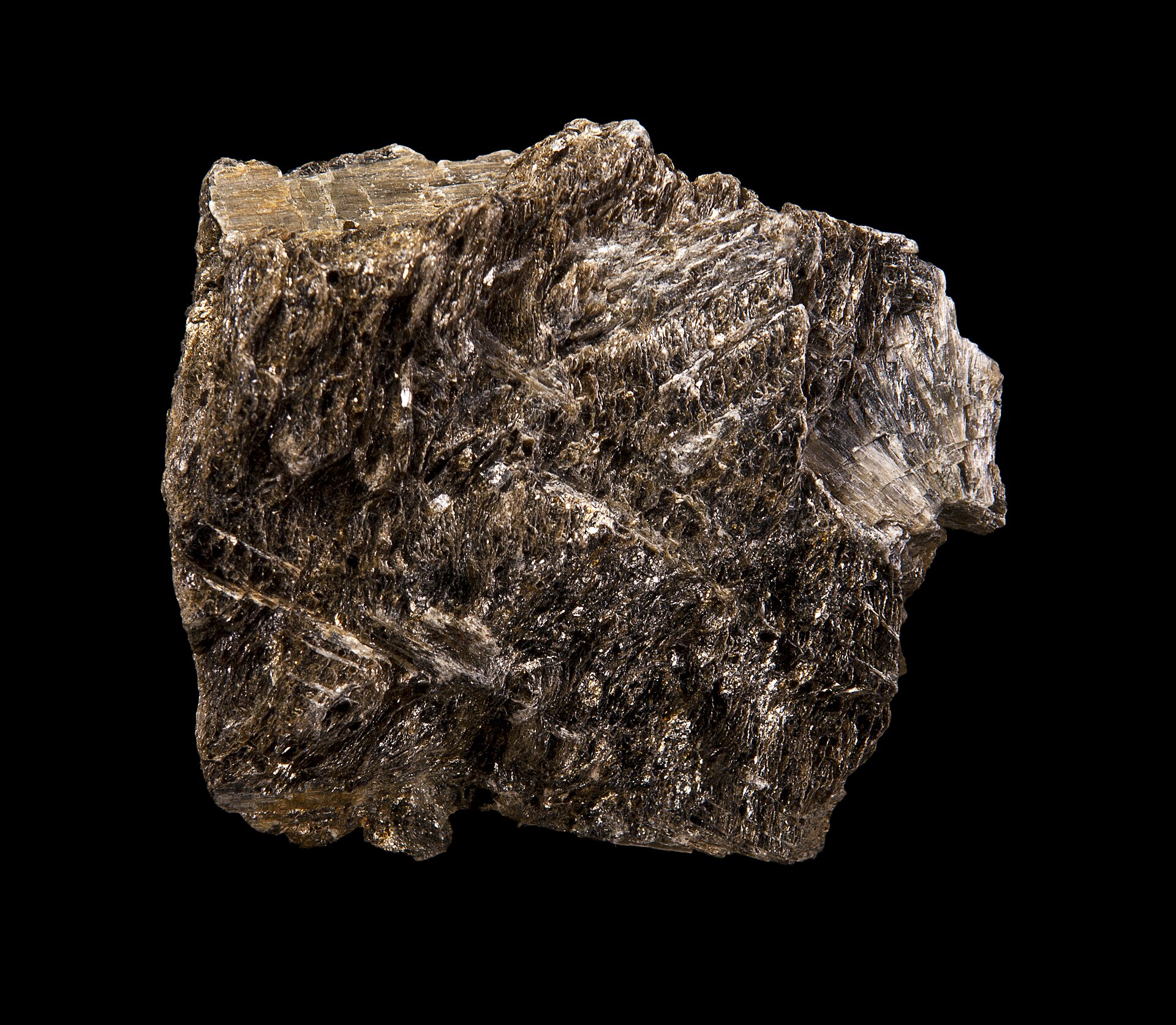
Anthophyllite - Kopparberg, Ljusnarsberg, Västmanland, Sweden - Size 47x43x30 mm — Photo: Didier Descouens · CC BY-SA 3.0
Anthophyllite
An orthorhombic amphibole of magnesium and iron — the high-temperature polymorph counterpart of cummingtonite.
Intro adapted from Wikipedia (CC BY-SA).
Anthophyllite is an IMA-recognized mineral species in the silicate class, with the chemical formula Mg₂Mg₅Si₈O₂₂(OH)₂.
It crystallizes in the orthorhombic crystal system (space group Pnma). It is a member of the Amphibole structural group.
Key properties: Mohs hardness 5.5–6; specific gravity 2.9–3.5; typically brown or gray or white or green; White or grayish streak; Vitreous, pearly on cleavage luster; refractive index 1.646; optically biaxial.
IMA symbol Ath, IMA status: approved, named in 1801.
From medium- or high-grade metamorphism, in amphibolites, gneisses, metaquartzites, iron formations, granulites, and schists derived from argillaceous sediments, ultramafic, or mafic igneous rocks; a retrograde reaction product.
It is found associated with Cordierite, talc, chlorite, sillimanite, mica, olivine, \hornblende, " gedrite, magnesio-cummingtonite, garnet, staurolite, plagioclase.
The name comes from the Latin anthophyllum, meaning clove, in allusion to the mineral's color.
Collections: Collector Favorites.