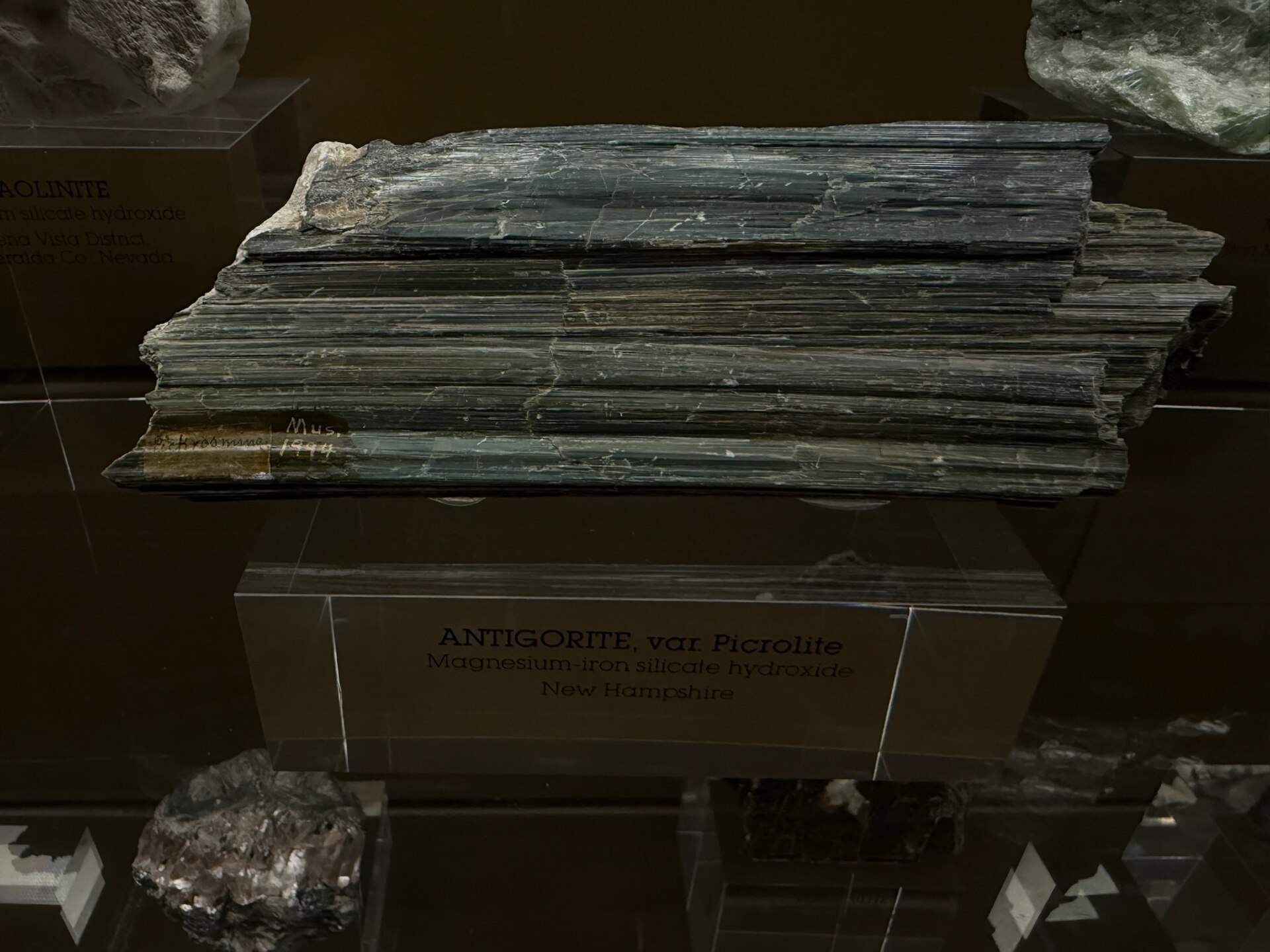
Antigorite — Photo: TheUltimateGrass · CC0
Antigorite
Also known as: Serpentine, Williamsite.
A serpentine-group phyllosilicate that survives to high pressures; it is a major water carrier in subducting slabs.
Intro adapted from Wikipedia (CC BY-SA).
Antigorite is an IMA-recognized mineral species in the silicate class, with the chemical formula Mg₃Si₂O₅(OH)₄.
It crystallizes in the monoclinic crystal system (space group Pm). It is a member of the Serpentine, Clay structural group.
Key properties: Mohs hardness 2.5–3.5; specific gravity 2.65; typically green or yellow or brown or white or gray; White streak; Resinous, greasy, silky, waxy, earthy luster; optically biaxial.
IMA symbol Atg, IMA status: approved, named in 1840.
Commonly replaces ultramafic rocks, pervasively or in crosscutting veinlets. As a replacement of siliceous dolostone along contacts with diabase sills.
It is found associated with Chromite, magnetite, chrysotile, olivine.
The name refers to the occurrence at Val Antigorio, Italy.
Collections: Everyday Minerals, Collector Favorites.