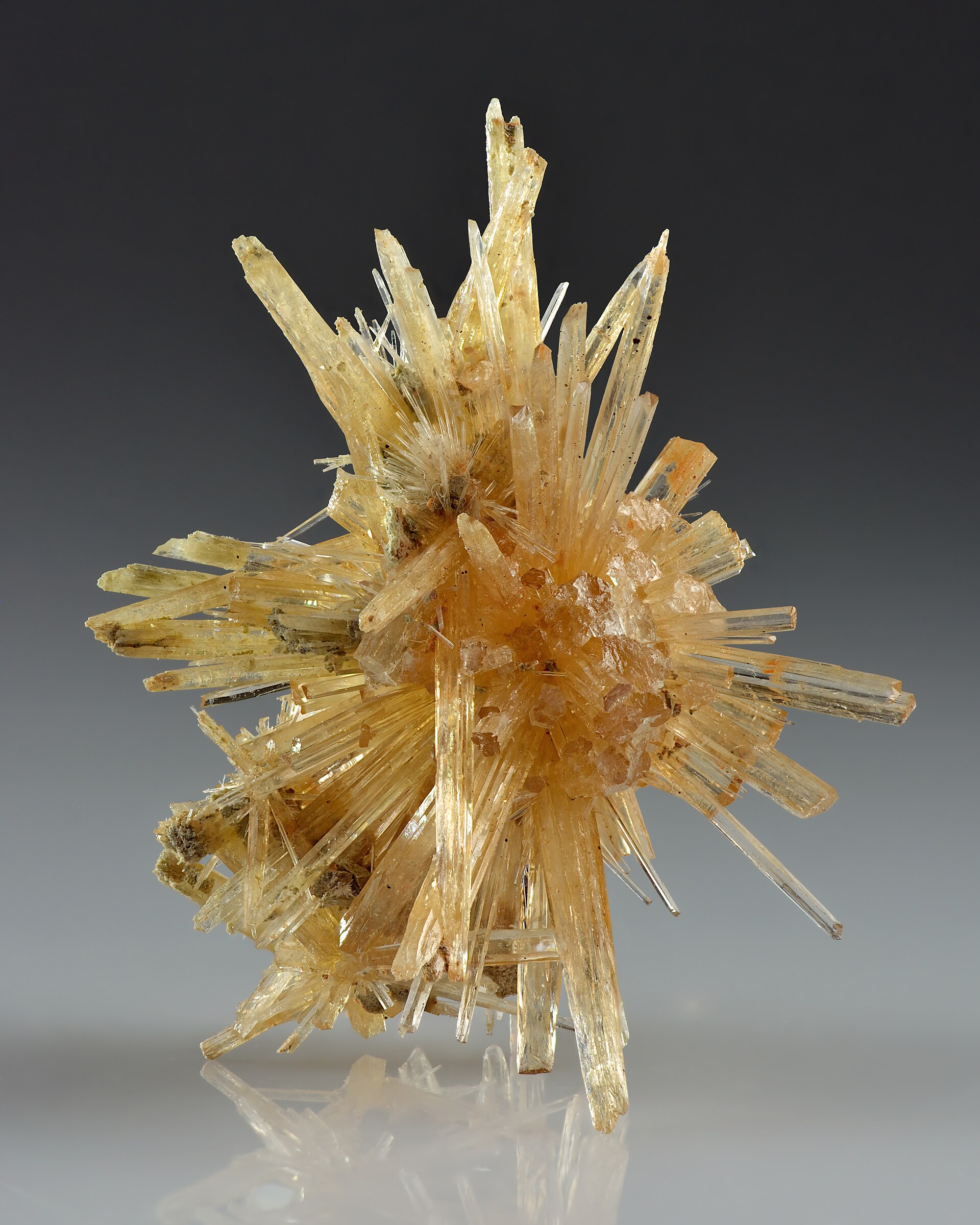
Aragonite crystal cluster (3 × 2.2 × 1.8 cm). Found from Pantoja, Toledo, Castile-La Mancha, Spain — Photo: Ivar Leidus · CC BY-SA 4.0
Aragonite
Also known as: Flos ferri.
The orthorhombic form of calcium carbonate — what pearls, shells and many cave formations are made of.
Intro adapted from Wikipedia (CC BY-SA).
Aragonite is an IMA-recognized mineral species in the carbonate class, with the chemical formula Ca(CO₃).
It crystallizes in the orthorhombic crystal system (space group Pmcn). It is a member of the Aragonite structural group.
Key properties: Mohs hardness 3.5–4; specific gravity 2.95; typically colorless or white or yellow or brown or blue or green or pink; White streak; Vitreous, resinous on fracture surfaces luster; refractive index 1.634; optically biaxial.
IMA symbol Arg, grandfathered status — known before the IMA’s founding, named in 1788.
Converts to calcite over geologic time. A primary precipitate in warm marine waters, as oolites and carbonate mud, a principal detrital sedimentary component as the hard parts of many marine micro-organisms, shells and skeletons.
It is found associated with Gypsum, sulfur, celestine (evaporite deposits); pumpellyite, lawsonite, glaucophane, quartz (blueschist); calcite, dolomite, hydromagnesite, brucite.
The name refers to its first-noted occurrence in the Aragon region, Spain.
Collections: Collector Favorites, Everyday Minerals.