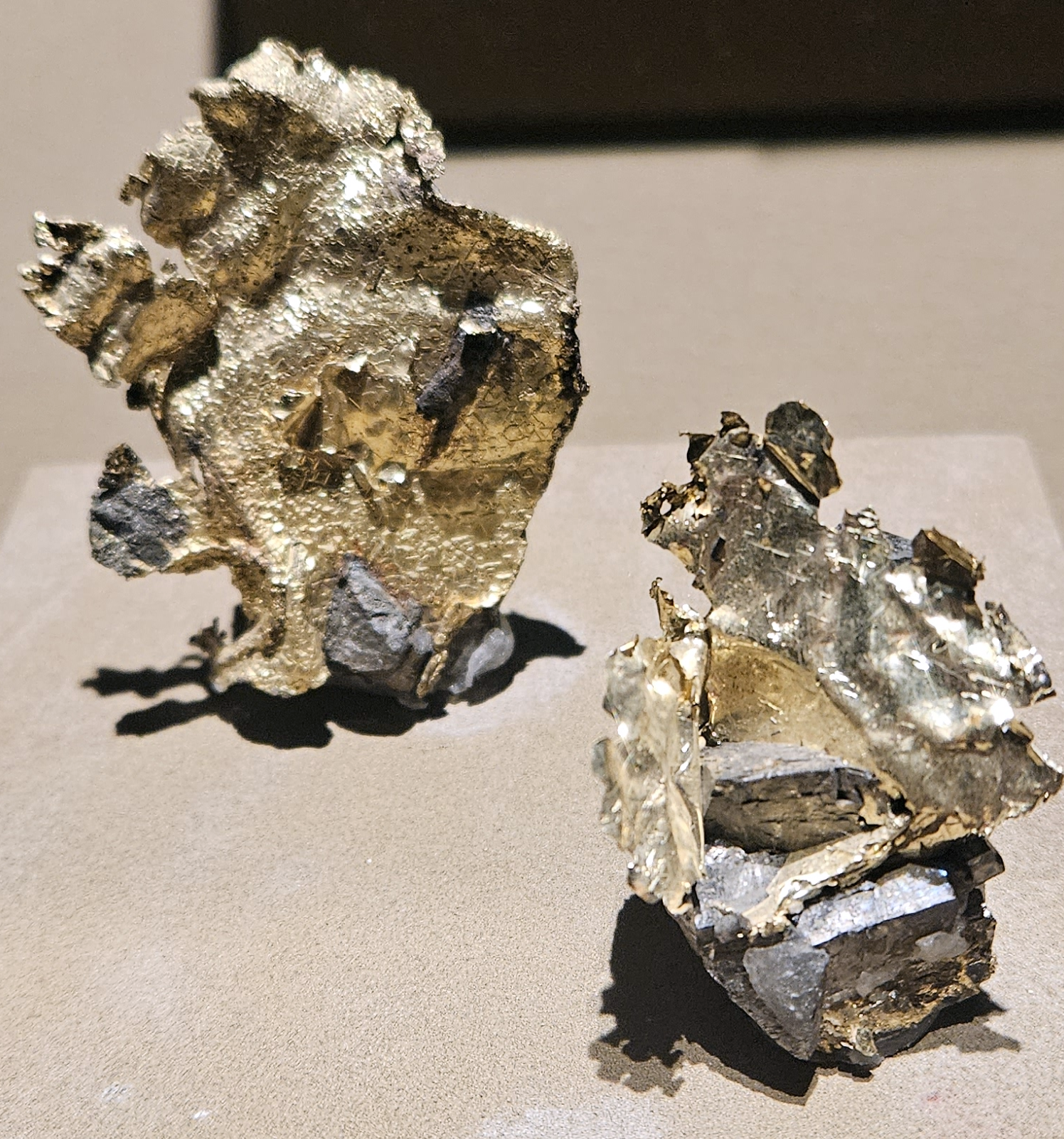
Sample of Gold with arsenopyrite collected from Sierra County, California, USA. On display at the Natural History Museum of Los Angeles County, Los Angeles, Cal — Photo: Eric Polk · CC BY-SA 4.0
Arsenopyrite
Also known as: Mispickel.
A hard, steel-grey iron arsenic sulfide — the most common arsenic ore mineral and an indicator of gold-bearing veins.
Intro adapted from Wikipedia (CC BY-SA).
Arsenopyrite is an IMA-recognized mineral species in the sulfosalt class, with the chemical formula FeAsS.
It crystallizes in the monoclinic crystal system (space group B2_1/d). It is a member of the Arsenopyrite structural group.
Key properties: Mohs hardness 5.5–6; specific gravity 6.07; typically gray or white; dark grayish-black streak; Metallic luster.
IMA symbol Apy, IMA status: approved, named in 1847.
Of hydrothermal origin, typically one of the earliest minerals to form. Found in pegmatites, high-temperature gold-quartz and tin veins, and in contact metamorphic sulfide deposits; less commonly of low-temperature hydrothermal origin.
It is found associated with Pyrrhotite, pyrite, chalcopyrite, galena, gold, scheelite, cassiterite, many other species.
A contraction of arsenical pyrites.
Collections: Metals & Native Elements, Collector Favorites.