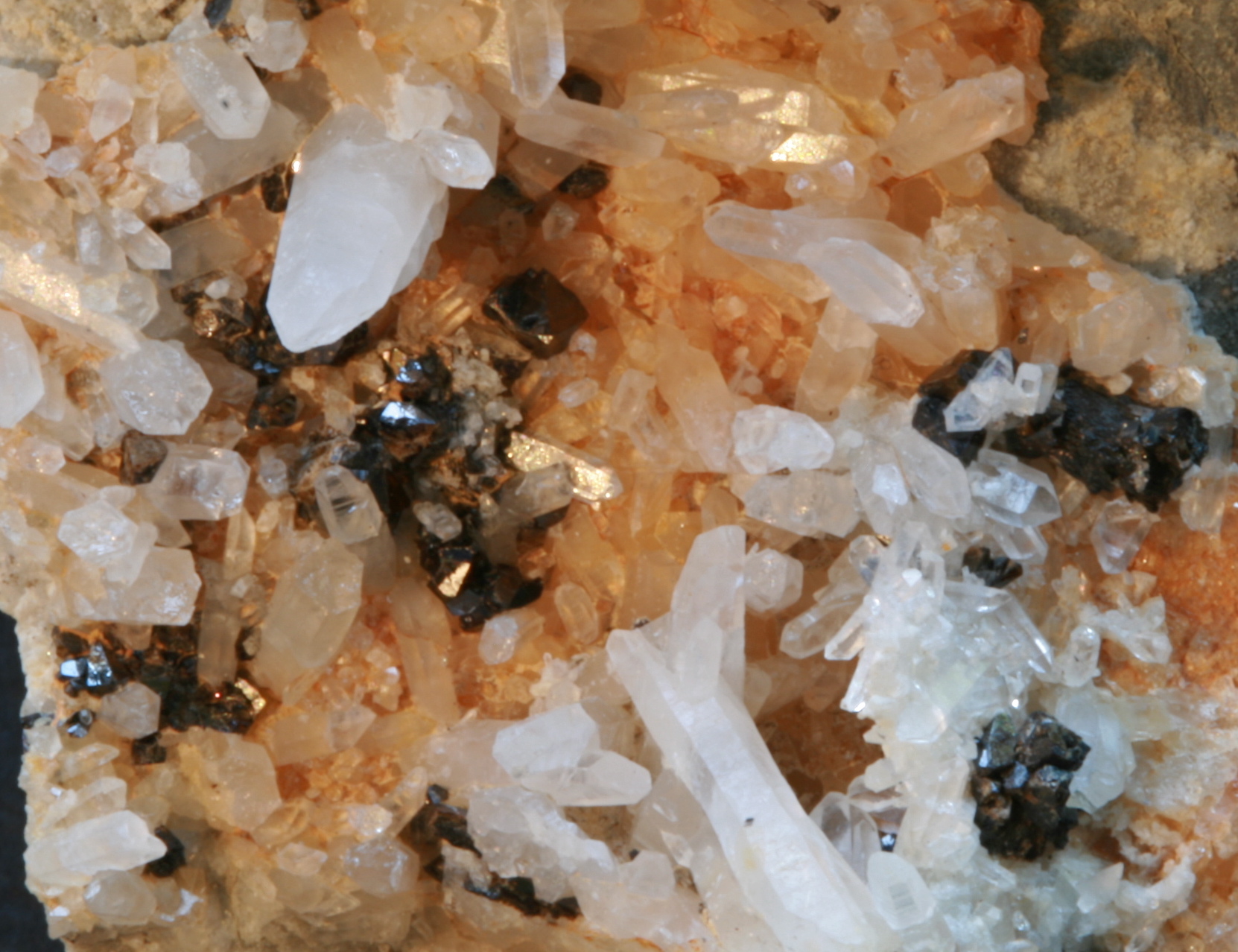
Bertrandite, Cassiterite, Quartz Dimensions: 45 mm; Field of view: 25 mm Locality: Mount Bischoff mine (Mt Bischoff mine), Waratah, Waratah district, Waratah-Wy — Photo: Ralph Bottrill · CC BY 3.0
Bertrandite
A colorless to pale-yellow beryllium silicate — an important beryllium ore — found in beryllium-rich pegmatites, often as an alteration of beryl.
Intro adapted from Wikipedia (CC BY-SA).
Bertrandite is an IMA-recognized mineral species in the silicate class, with the chemical formula Be₄Si₂O₇(OH)₂.
It crystallizes in the orthorhombic crystal system (space group Cmc2_1).
Key properties: Mohs hardness 6–7; specific gravity 2.59–2.6; typically colorless or white or yellow; white streak; Vitreous, pearly on {001} luster; refractive index 1.603; optically biaxial.
IMA symbol Btd, grandfathered status — known before the IMA’s founding, named in 1878.
Found in fissures in granites and associated pegmatites and in miarolitic cavities in greisens; commonly an alteration product of beryl, more rarely as a primary mineral.
It is found associated with Beryl, phenakite, herderite, tourmaline, muscovite, fluorite, quartz.
The mineral was named to honor Emile Bertrand (1844–1909), French mineralogist.
Collections: Collector Favorites, Rare & Remarkable.