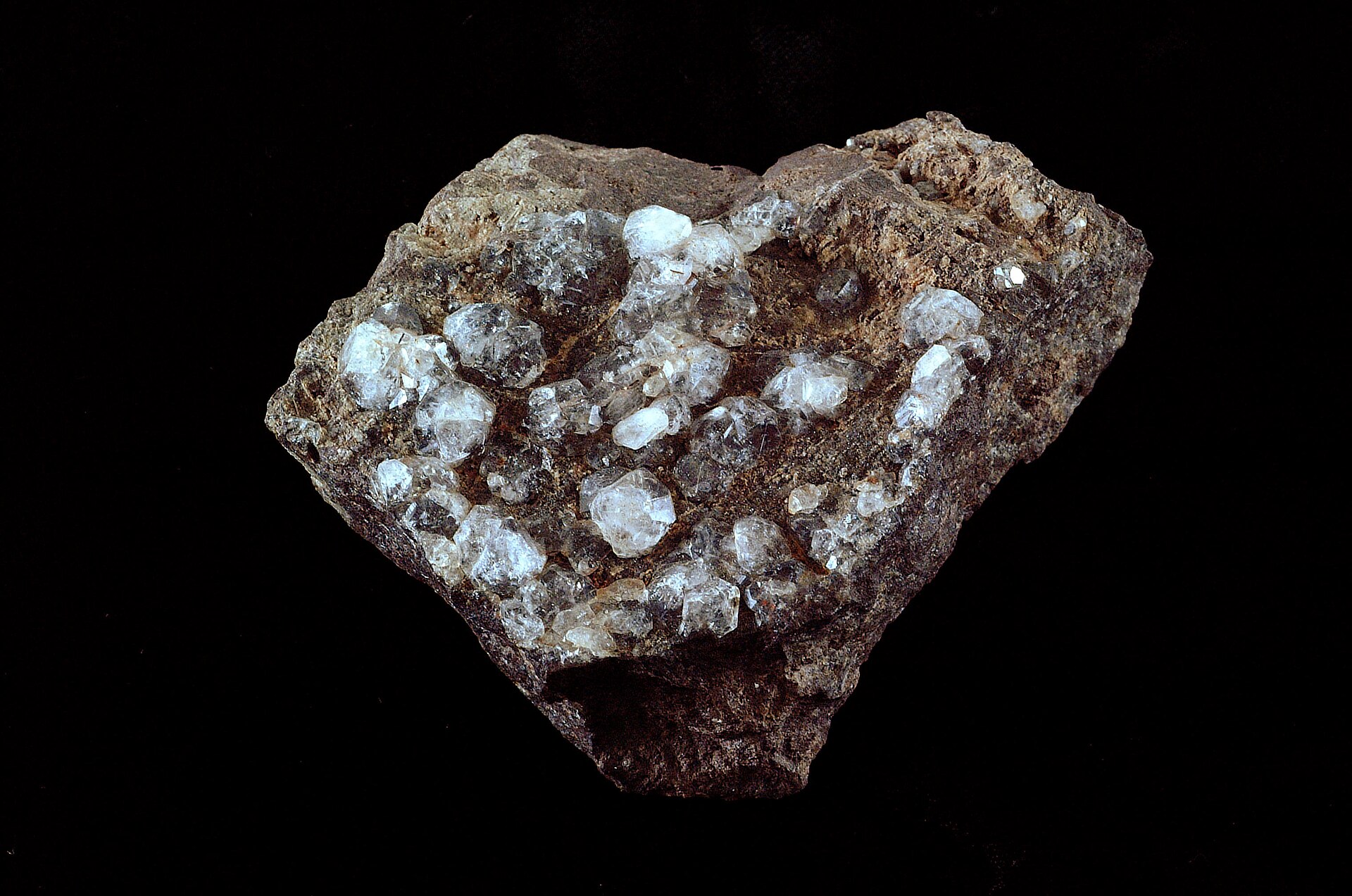
The brown material is braunite, a manganese silicate; the white crystals are quartz. This specimen comes from Langban, Sweden, and is 7.5 cm across. — Photo: Shannon Heinle · CC0
Braunite
A manganese silicate-oxide containing manganese in two oxidation states, commonly with iron, calcium and other substitutions.
Intro adapted from Wikipedia (CC BY-SA).
Braunite is an IMA-recognized mineral species in the silicate class, with the chemical formula Mn²⁺Mn³⁺₆O₈(SiO₄).
It crystallizes in the tetragonal crystal system (space group I4_1/acd). It is a member of the Braunite structural group.
Key properties: Mohs hardness 6–6.5; specific gravity 4.72–4.83; typically brown or black; Brownish black to steel-gray streak; Submetallic. Anisotropism: Weak in air to distinct in oil, dark to lighter slate gray. R1 {R2: (400) 23.4–25.4 luster.
IMA symbol Bnt, grandfathered status — known before the IMA’s founding, named in 1828.
Formed by metamorphism of manganese silicates and oxides; also a product of weathering.
It is found associated with Pyrolusite, jacobsite, hausmannite, bixbyite, rhodonite, spessartine, hematite.
The mineral was named to honor Kammerrath [Advisor of the Chambers] Braun of Gotha, Germany.
Collections: Collector Favorites, Metals & Native Elements.